
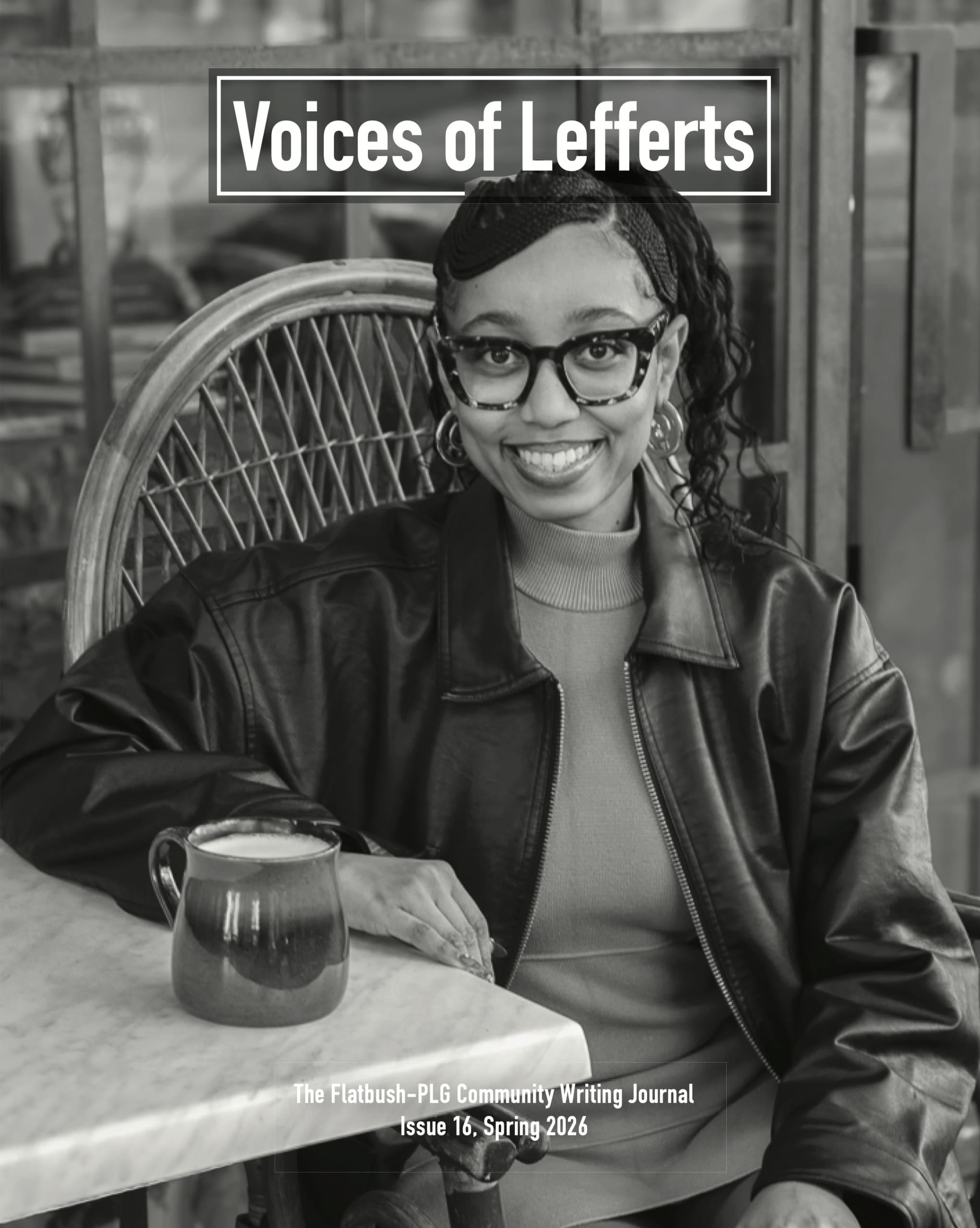
Issue 16, Spring 2026
Dez (Samantha Marte)
5pm on the L Train
David Stoelting
The Negro Leagues and Black Baseball in Brooklyn
Brenda Edwards
Still Standing in PLG/Flatbush
Danie Herard (featured artist)
Kiana Marte
Brooklyn, A Brick
Parminder Kaur
A Journey Through Brooklyn’s Past
Alexis Hutchinson
On the Subject of Books: Black-Owned Literary Spaces in Brooklyn
Oral History Excerpts
– Charkie Quarcoo interviewed by Sarah Schuster
– Vivian Burns interviewed by Norma Williams
Editorial Perspectives: The 1919 Elaine Massacre in Arkansas and Black Brooklyn
I started drafting this editorial on September 30, 2025, the same day 106 years ago that one of the deadliest episodes of racial violence in US history occurred in Elaine, Arkansas.
As we were making plans for our project “Mapping Black History in Brooklyn”—applying for grants, fleshing out ideas for aspects of the project, deciding on dates—I heard from Julia Wright, Richard Wright’s daughter, about a commemoration for the Elaine massacre. Richard Wright had lived in Elaine for two years, from 1916 to 1918, with his mother Ella, brother Leon, Aunt Maggie, and her husband, Uncle Silas Hoskins, a saloonkeeper. Hoskins had been threatened many times by white people who envied his thriving business. One night in 1917, when Richard was nine years old, Silas failed to return home. A young Black man came to tell Maggie that he had been shot; he was dead. That lynching, Julia Wright has come to believe, was a pivotal experience in her father’s life that he recounted in his autobiography Black Boy—a trauma that would haunt him for the rest of his life.
Just two years later, in 1919, the massacre occurred, an event that Wright would have certainly known about, even though he never refers to it in Black Boy. Black sharecroppers in Elaine had formed the Progressive Farmers and Household Union of America (PFHUA) and were meeting in a local church to strategize how to get better prices on cotton crops from white plantation owners who dominated local commerce. As historian Paul Ortiz explained in a 2022 Democracy Now segment about the massacre, many sharecroppers and Black residents who owned land had begun organizing, emboldened by their return from military service overseas in World War I only to find Jim Crow laws still in place at home. Threatened by the rapid growth of the union and the sharecroppers’ demands for better prices, the capitalist white power structure unleashed orchestrated violence and legal maneuvers to maintain economic and political control.
On the night of September 30, 1919, approximately one hundred local sharecroppers attended a PFHUA meeting at a church in Hoops Spur, a few miles outside Elaine. Contesting both white supremacy and capitalism, the sharecroppers were labeled as communists and Bolsheviks. They were one of many unions, including the Industrial Workers of the World, organizing militant strikes and other job actions that heightened tensions across the country. Armed Black guards stood outside the church to prevent white patrollers from disrupting the meeting. A shoot-out between them and three white men sitting in a nearby parked car ended in the deaths of two white people. At daybreak, a posse entered Elaine to arrest dozens of Black suspects while 500 to 1,000 white people from surrounding counties amassed to put down the so-called “insurrection.” The next day the invading white mob, together with US troops from Camp Pike that had been requested by Arkansas Governor Brough, slaughtered Black residents in the streets, resulting in an estimated 100 to 240 casualties reported by some sources, and hundreds more according to others. Sixty-seven Black people were arrested and charged with inciting violence. Dozens more faced other charges. No white people were prosecuted, while 12 Black PFHUA members were wrongly convicted of murder charges and sentenced to death. Known as the Elaine Twelve, their sentences were eventually overturned, and they were freed thanks to a lengthy legal battle led by the NAACP.
In his autobiography, Wright wrote about his Uncle Silas’s lynching: “There was only silence, quiet weeping, whispers, and fears. Uncle Hoskins had simply been plucked from our midst and we, figuratively, had fallen on our faces to avoid looking into that white-hot face of terror that we knew loomed somewhere above us. This was as close as white terror had ever come to me and my mind reeled. Why had we not fought back, I asked my mother, and the fear that was in her made her slap me into silence.” Wright has often been viewed by critics as angry, humorless, and overly didactic in what James Baldwin disdained as “the protest novel.” But Black Boy is replete with profoundly tender passages in the story Wright tells—giving voice to Black boys he grew up with—from the perspective of a child who bore witness to his mother’s immense suffering from a stroke and the racial terror he endured. That terror never completely dissipated, permeating even his most exuberant boyhood discoveries of the wonder of the world with the “tensity,” a word he often invoked, of growing up Black in the Jim Crow South.
When Julia Wright contacted me and other members of the Richard Wright Society about the museum, she was raising money for a memorial garden for Silas Hoskins to be created as part of the museum. I was deeply moved by these efforts to preserve a history that I had only become partially aware of in the course of researching a book I recently published on Wright’s life and work titled No Race, No Country: The Politics and Poetics of Richard Wright.
That Julia’s request for donations to the garden dovetailed with the planning stages for our project “Mapping Black History in Brooklyn,” in collaboration with Shanna Sabio and GrowHouse Design & Development Group, raised a flurry of questions for me: What could we learn about the connections between Arkansas and Brooklyn, the agrarian South and the industrial North, the loss of land of free Black and Indigenous peoples in Brooklyn and the loss of Black-owned land in Elaine? Were there parallels between sharecroppers who organized in the South in the early 20th century and the collective struggle of sharecroppers in Brooklyn before the abolition of slavery in New York State in 1827? What can we find out about Black workers after 1827 who provided the main source of labor on what would remain mostly farmland until the middle of the century, supplying food to Manhattanites? Could we form a sisterhood with Elaine like some US cities had become sisters with Nicaraguan and Salvadoran towns in the late 20th century?
None of these questions has been answered, though some project participants are still working on essays that may shed light on them, researching who worked on Brooklyn farms and under what conditions after abolition. As I reflected on what to focus on for the editorial-perspectives column for this issue, it occurred to me to add these stories of Silas Hoskins, the PFHUA, the Elaine massacre, and their legacies to our mapping project—to add Elaine, Arkansas, to the map as symbolic of so many points of departure to Brooklyn, marked by centuries of struggle and suffering but also of resistance, determination, and joy—documenting the wider world that infuses the borough and makes Flatbush what it is today. Sadly, when I searched for the museum on the internet, I discovered dead links. I hope this is temporary and that the museum, the civil rights center, and the Silas Hoskins Garden are still there and thriving. At the same time, I can’t help but wonder if they have felt the impact of the Trump administration’s dismantling and hollowing out of government agencies, including the National Endowment of the Humanities (one of the project’s funders) and other presidential decrees that are erasing this history before it fully penetrates public consciousness and takes root in sites like the former Lee Grocery Store at the intersection of Main Street and Quarles Road in Elaine.
These federal attacks on research, arts, and humanities grants as well as on education, libraries, and museums cost Voices of Lefferts and GrowHouse Design & Development Group a significant loss of funding awarded by Humanities New York at the beginning of 2025. But, like so many other groups and individuals nationwide, when we asked project team members and participants if we should press on without funds, everyone answered a resounding “yes.”
* * *
IN THIS ISSUE, we are thrilled to present poems, essays, artwork, and oral history excerpts on the theme of mapping Black history in Brooklyn—a theme that I have tried in the above reflections to tie to the larger project of mapping Black history (all of our history) in and beyond the US.
In 5pm on the L Train, Dez (Samantha Marte) reflects on the history of Brooklyn in short, visual takes on the borough’s ever-changing realities. “I used to count how many white people I saw,” she writes. “But now I find myself counting how many people like me I still get to see.” Ultimately, she suggests, “[M]aybe I should start a riot. Maybe I shouldn’t stay quiet.”
David Stoelting brings us a more specific piece of local Black history in The Negro Leagues and Black Baseball in Brooklyn. Some 200 years ago, baseball evolved in Brooklyn from the ball-and-bat games played by immigrants. David tells the dramatic story of how the working-class but racially segregated sport played by everyone broke the color line in the major leagues.
In Still Standing in PLG/Flatbush, Brenda Edwards reports on continuing racial inequities in housing despite legal protections and a belief that redlining and racial bias in real estate markets are discriminatory practices of the past. Discovering the use of AI logarithms, she observes that, “AI can be just as biased” given its derivation from “a long history of racist policies.”
This issue’s featured artist, Danie Herard, offers a series of inner landscapes mapping the emotional terrain of Black history in Brooklyn. From a geometric black-and-white drawing to richly colored abstractions to the delicate etchings of a radiant face in profile, Danie draws on our collective unconscious to excavate maps of nightmares, dreams, and feelings.
In Brooklyn, A Brick, Kiana Marte meditates on coffee soaked with blood. “My neighborhood is changing,” she writes, “and I’m forced to grieve.” Just as she sees herself and her city reflected in a cup of black coffee, she interrogates self-deception, whiteness, and blackness in “White Lies,” a poem ultimately of defiance and survival.
A student intern for VoL, Parminder Kaur reflects in A Journey Through Brooklyn’s Past on writing workshops and site visits for which she served as a notetaker, providing detailed reports of each session. The project, she concludes in a testament to the power of documentary work, “has inspired me to learn about the past and continue the work of those who came before me.”
In On the Subject of Books: Black-Owned Literary Spaces in Brooklyn, Alexis Hutchinson maps Black-owned bookstores, centers, and boutiques in the borough, interviewing the owners and collating addresses, contact information, hours of operation, and websites. “To me,” she writes, “Black literary spaces have always been a haven, a necessity”—bringing into being “something beautiful and expansive.”
We are pleased once again to feature excerpts of interviews from our oral history collection. In an interview with Sarah Schuster, Charkie Quarcoo, a 41-year-old Brooklyn native, recalls growing up in Park Slope and moving to Flatbush, speaking eloquently about her role in the Maple Street Community Garden and her efforts to bridge generational and cultural gaps. Interviewed by Norma Williams, Vivian Burns recalls growing up on Parkside Avenue and attending P.S. 92, Jackie Robinson I.S. 320, and Medgar Evers College. She goes on to reflect on her community involvement, the impact of gentrification, mental health issues, and the need for better tenant-landlord relations to build an inclusive, sustainable community.
* * *
The Project Team
Thanks as always to the project team—editors Brenda Edwards, Norma Williams, Rina Kleege, Carol Pittman, Sarah Schuster, and Alexis Hutchinson; photographers Nancy Treuber and Neil Carpenter; copyeditors Sanjay Surana and Kris Walkes; and graphic designer Frank Marchese. Welcome to Jenn Shin, an urban ecologist and artist whose line drawings are a new feature of the journal. Special thanks to Shanna Sabio for guiding our journey to map Black history in Flatbush, including her walking tour of the Flatbush African Burial Ground, and to Dylan Yeats and Riah Kinsey for hosting us at Lefferts Historic House; Dominique Jean-Louis for giving us the tour of “Trace/s” at the Center for Brooklyn History; and Erica Harper and the tour guides for hosting and leading us through the three historic houses at the Weeksville Heritage Center that were inhabited by members of this historic free Black community. We are also deeply grateful to the Brooklyn Arts Council (BAC) for awarding us a Local Arts Grant, made possible with funds from the Statewide Community Regrants Program, a regrant program of the New York State Council on the Arts with the support of the New York State Legislature and administered by BAC. Finally, a shout-out to Compound Cowork, which has become our home for in-person workshops, author readings, and other events, and to Park Slope Copy Center for continuing to print the journal and help us bring each issue into the world. And thanks to you, dear reader, for supporting our work; it is for you that we exist.
By Deborah Mutnick