
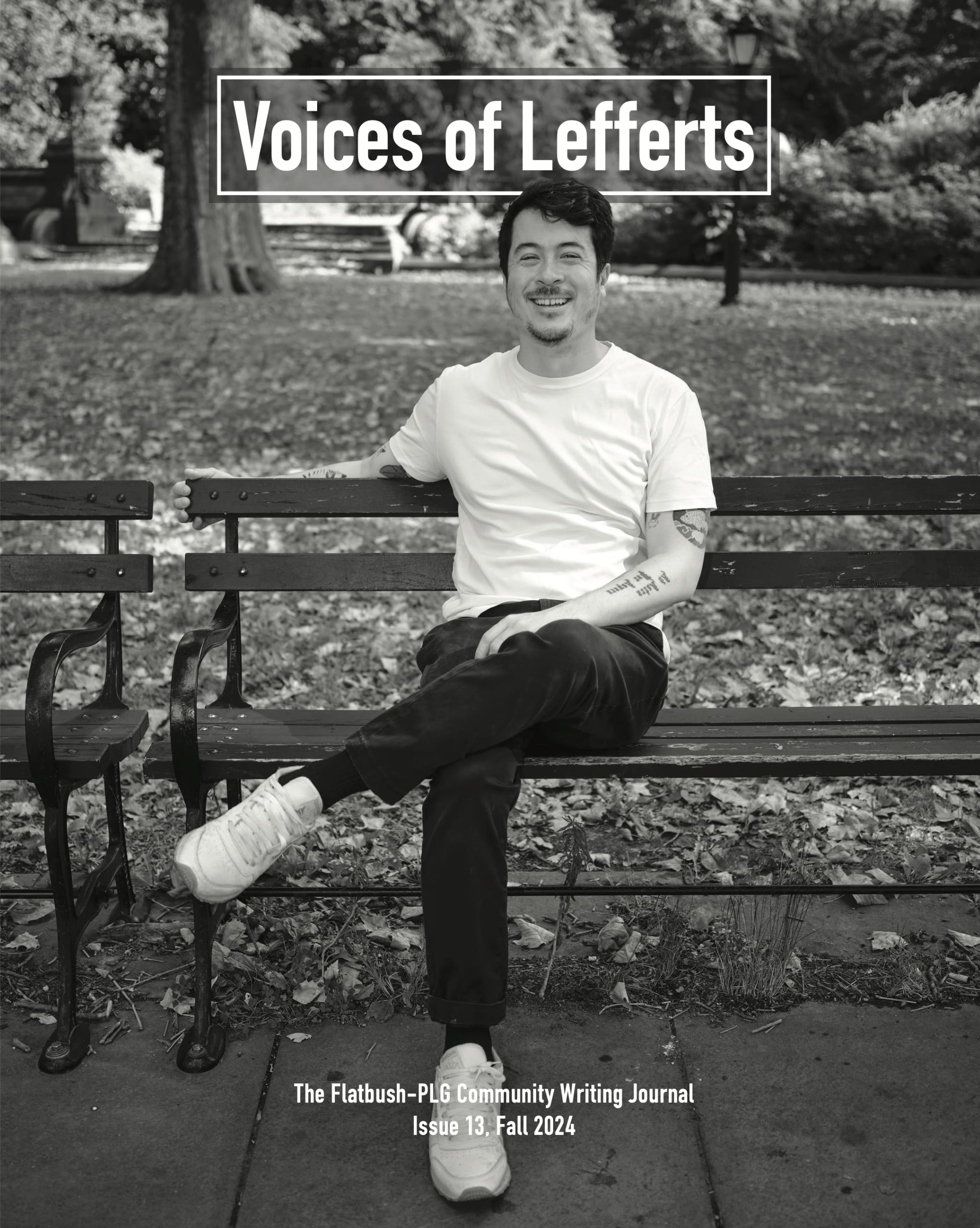
Issue 13, Fall 2024
Zhenia Nagorny
Everything Is Sacred
Chris Villanueva Blackett
When a Fire Starts to Burn
Gail Nurse
The Fire
Prasana William
Not That Kind of Indian
Rachael DePalma
Around the Fig Tree: The Understory of Us All
a bee roach
Letter from Flatbush, 2068
Myrah Brown Green (featured artist)
Our Covid-19 Collection
– Grace Calame-Mars interviewed by Nancy Hoch
– Bonnie Bader interviewed by David Stoelting
– Cheryl Sealey interviewed by Norma Williams
Editorial Perspectives: Imagining a Cooler, Brighter Future in the Hottest Summer on Record How Our Collective Story Challenges American Mythology
As I sit down to introduce this issue, looking out my window at green and red foliage against a cloudless blue sky, I think about how hot it has already been this summer and about Roxanne Dunbar-Ortiz’s reframing of America’s origin story in her book An Indigenous People’s History of the United States. Just two weeks into July, New York City is experiencing its third heat wave. The New York Times reports that 102 major cities are forecast to have dangerous levels of heat in the weeks to come, some of them as high as 117 degrees Fahrenheit. In Mexico and Central America, temperatures have risen to 125 degrees Fahrenheit. Billions of people across five continents are reeling from the hottest temperatures on record, resulting in dozens of deaths in June in New Delhi and hundreds in Saudi Arabia during this year’s pilgrimage to Mecca.
Here, we can take refuge in the park, the Botanic Garden, or tree-filled backyards, but parts of Brooklyn, including Flatbush, that were redlined from the 1930s to the 1960s—deemed unsafe for lending because Black households predominated—have fewer green spaces, trees, and relief from the heat. Not surprisingly, Black New Yorkers are twice as likely to die from exposure to extreme heat than white residents. Legacies of slavery and Jim Crow are inscribed in the streets of Central Brooklyn and other inner cities by federal and local policies and practices, ghettoization, urban “removal,” and generations of poverty. In much the same way, colonial history wrote the map of the US, erasing the contours of lands of Indigenous peoples across the continent, now radically diminished and concentrated in reservations, impoverished, subject to water and air pollution, industrial waste, and barren soil. Dunbar-Ortiz writes, “Everything in US history is about the land—who oversaw and cultivated it, fished its waters, maintained its wildlife; who invaded and stole it; how it became a commodity [‘real estate’] broken into pieces to be bought and sold on the market.”
These intertwining forces of the globalization of capital are responsible not only for tens of millions of deaths and dispossession of Indigenous, enslaved, and formerly enslaved peoples but also for centuries of persistent worldwide social disparities in health, education, housing, jobs, income, wealth, and other measures of wellbeing. As we begin collectively to confront these histories and the forms they took from the transatlantic slave trade to settler colonialism to outright theft of land, we can also begin to unravel the myth of America as manifest destiny, of the heroic founding of a “new world,” a revolutionary force for democracy that overthrew an oppressive English king, boldly pushing westward, settling virgin land in an unoccupied Eden, and going on to become the supremely rich, powerful, “leader of the free world.”
Here is Dunbar-Ortiz again: “The history of the United States is a history of settler colonialism—the founding of a state based on the ideology of white supremacy, the widespread practice of African slavery, and a policy of genocide and land theft.” It is this same history that accounts for massive environmental depredation—land stripped of fertile soil, deforested woodland, diverted rivers, mountaintops blasted by mining, and carbon dioxide emissions from fossil fuels polluting the air and poisoning the atmosphere. Without romanticizing the past or abandoning a materialist view of the development of capitalism, which, according to Marx and Engels, “rescued a considerable part of the population from the idiocy of rural life,” sweeping away the fetters of feudalism, we can imagine various historical conjunctures that might have led to a more egalitarian, peaceful, humane world able to survive today’s existential crisis of climate change. Instead, as I wait for a thunderstorm to burst across a suddenly dark, sullen sky, the actual world in which we live has been severely compromised, perhaps past the point of redemption, by a much faster acceleration of global warming than climate scientists had previously warned, with international leaders failing to respond to the crisis with the alacrity demanded by the planet and its desperate masses of people, animals, and plants.
We have a collective story to tell in Flatbush-Prospect Lefferts Gardens that challenges American mythologies. We can see it in efforts to document, preserve, and memorialize the Flatbush African Burial Ground at the corner of Church and Bedford Avenues. We can see it in the Prospect Park Alliance’s determination to reimagine Lefferts House from the perspective of the enslaved people who lived there, the Indigenous peoples whose land the Dutch stole, and the successive generations of dispossessed, transplanted, and struggling immigrant communities that built and enriched Brooklyn. We can see it in the work of the Maple Street Community Garden to compost food scraps, provide access to fresh food, and create a beautiful space for community gatherings, education, and gardening; we can see it in the efforts of PLG Arts and Brooklyn FAM (Festival of Arts and Music) to bring visual, performing, and literary arts to the neighborhood; the historic work of Lefferts Manor Association, which celebrated its centennial in 2019; and in the mission of the Prospect Lefferts Gardens Neighborhood Association, which fought a successful battle in the 1970s against redlining, helped organize tenants into tenant associations, and mobilized blocks to form block associations.
Since 2017, Voices of Lefferts has also contributed to that collective story, aiming to document the neighborhood’s history in the words, images, and voices of the people who live here. This people’s history weaves personal stories together with social, political, economic, and environmental research, reportage, analysis, and insight to assert what Henri Lefebvre called our “right to the city” and to contribute to efforts to stop unfettered development, to protect longtime residents threatened by rising rents, unaffordable prices, and displacement, and to do what we can to imagine and create a society that serves everyone’s needs. Simply by inviting anyone in the neighborhood to join our free writing workshop, participate as a narrator in an oral history interview, or learn how to conduct an interview, we are opening up a radical space for everyone’s voice to be heard.
OUR CURRENT ISSUE speaks to that vision with six pieces that chronicle love, loss, discovery, hardship, and resilience, recovering the past and looking to the future. In Everything Is Sacred, Zhenia Nagorny meditates on life, nature, and composting. Like a deft spider, she spins a microcosmic tale of the universe that takes us from the “black abyss of interstellar space” to the Maple Street Community Garden, paying tribute along the way to the Lenni Lenape people who “lived in symbiotic relationships with the land” and “practiced companion farming that supported and complemented the growing ways of plants and all their kin.” She goes on to recall the twenty-first-century battle to preserve the garden from “greedy developers,” explaining that it was compost—“nature’s default setting”—that called her there. “The land,” she writes, “remembers everything.”
Chris Villanueva Blackett contemplates both his own future as a young New Yorker who probably cannot afford to remain in the city he loves and a short history of the city’s educational system in When a Fire Starts to Burn. A former Success Academy teacher worried about the rise of charter schools and the resegregation of public education; he “wants to write about everything that came before me because it helps me understand my own relationship to…these city blocks.” Invoking the establishment of Colored School 1 in 1827, its conversion to PS 67 in 1898, and the persistent failure of NYC schools to deliver quality education to all the city’s children, he wrestles with the response of a friend who tells him that the only solution to the failures of the educational system is to “Burn it down!”
Relating the story of an actual fire, Gail Nurse’s essay, simply titled The Fire, attests to the impact on her and 17 other tenants left homeless for more than two years after a three-alarm fire destroyed 18 apartments in her six-story, 36-unit building. When she was able to return to her ruined apartment with a police officer to retrieve some of her belongings, she saw a surreal scene that “looked like a kid’s swimming pool. Everywhere was water. The walls were missing… The ceiling was open or missing.” At the time of the fire, she writes, the building had 386 open violations with the Department of Housing Preservation. Everyone suffered “lots of losses. You name it, we lost it!”
In Not That Kind of Indian, Prasana William puts a local twist on the universal story of moving somewhere new and grappling with one’s identity. In this case, after moving four times in five years, she decides to settle in Prospect Lefferts Gardens where, walking down Nostrand Avenue, she feels a sense of relief from a burden that she didn’t realize she had been carrying after living in the “uniformly Scandinavian plains of Iowa.” But settling in PLG also means contending with her East Indian roots in a predominantly West Indian neighborhood—she notes that “Here in PLG, ‘Caribbean’ is the preferred identifier”—as she reflects on the Indian diaspora that links the two populations.
Rachael DePalma echoes Zhenia’s prayer to nature in Around the Fig Tree: The Understory of Us All. Like so many essays in Voices of Lefferts, Rachael braids her own story—her Italian roots, her job in PLG at a nursing home, surviving the pandemic, and discovering composting at the Maple Street Community Garden—together with a story about figs. In the midst of the pandemic, her landlady hands her a bag of figs, a “fleshy fruit” with a “filament of pulp,” a “juicy core and seedy inner texture” far different from the Fig Newtons she remembers eating as a kid. Rachael goes on to recount the fig tree’s history from Buddha in India to Adam and Eve to the Egyptian goddess Hathor to the Kenyan god Ngai.
Finally, a bee roach gives us Letter to Flatbush, 2068, speculative fiction about Flatbush circa 2068. In a sort of love letter to their deceased mother, Luca tells her the magnolias bloomed on her birthday this year, tipping us off that Brooklyn has become hotter than ever and has been reclassified as a subtropical climate in our times. Ten stories up in the “cardboard penthouse” of an old building, they describe more hideous buildings than we lament in 2024, “big thyme” that grows in Brooklyn, a.k.a. “Cuban oregano, Mexican mint, Spanish thyme, or Indian borage,” their mother’s holographic blue cat Carlisle that is about to die without a battery charge, subway stops that have become gardens, and much more.
We are also honored to feature artwork by master quilter and art historian, curator, and agent Myrah Brown Green, as well as three oral history excerpts from our Covid-19 collection of interviews with Grace Calame-Mars (interviewed by Nancy Hoch), Bonnie Bader (interviewed by David Stoelting), and Cheryl Sealey (interviewed by Norma Williams). Given the summer 2024 uptick in this year’s FLiRT variants of Covid, we asked each narrator to reflect on how their words from 2020 strike them now, four years later, and what a reader might want to know about their experience since then.
* * *
INSPIRED BY A BEE ROACH’S speculative fiction, Voices of Lefferts held a story circle on May 31 in the Maple Street Community Garden, calling together people in the neighborhood to tell stories about Flatbush 2050. Eighteen of us met that Friday afternoon to sit in a circle on a sunny, cool spring day under the splendid weeping willow tree that arches over half the garden. From dystopian visions of life in the near future to determined hope for a new chapter of human history—the image of children in the lead, made wiser by their elders’ failure to stave off calamity, popped up in story after story—the stories edified, amused, troubled, excited, saddened, and moved us to tears and laughter. For that cool, blue-skied, sun-speckled hour under the protective branches of the willow tree, we noted threats to our future from the local to the global, from Mayor Eric Adams’s “City of Yes” plan incentivizing developers through massive rezoning and intensifying dispossession of working-class New Yorkers, to the global climate crisis and record-breaking heat waves, AND we imagined a future that we want for ourselves and our children—a classless, peaceful, sweeter, more equal, hopefully, cooler world of abundance, friendship, love, creativity, and light.
* * *
Excerpts from the story circle will be published in issue #14, scheduled to appear in February 2025. For now, as always, let me acknowledge all those who made this issue of the journal possible: oral history director Jon Earle; oral history assistant directors Kimberly Denise Williams and Isoke Senghor; website and project manager Liz Oliver—a sad farewell to Liz who needs to step down from the project team after successive promotions in a job she loves; coaches Brenda Edwards, Rina Kleege, Andrea Phillips-Merriman, and Norma Williams; copyeditors Sanjay Surana and Gillian Arthur; photographers Nancy Treuber and Neil Carpenter; and graphic designer Frank Marchese. Thanks also go to Park Slope Copy Center, LIU Brooklyn, the Prospect Lefferts Gardens Neighborhood Association, PLG Arts, Loud Baby, Dorsey’s Fine Art Gallery, and CaribBeing. And thanks, as always, to all of you, dear readers, for your support for Voices of Lefferts!
By Deborah Mutnick