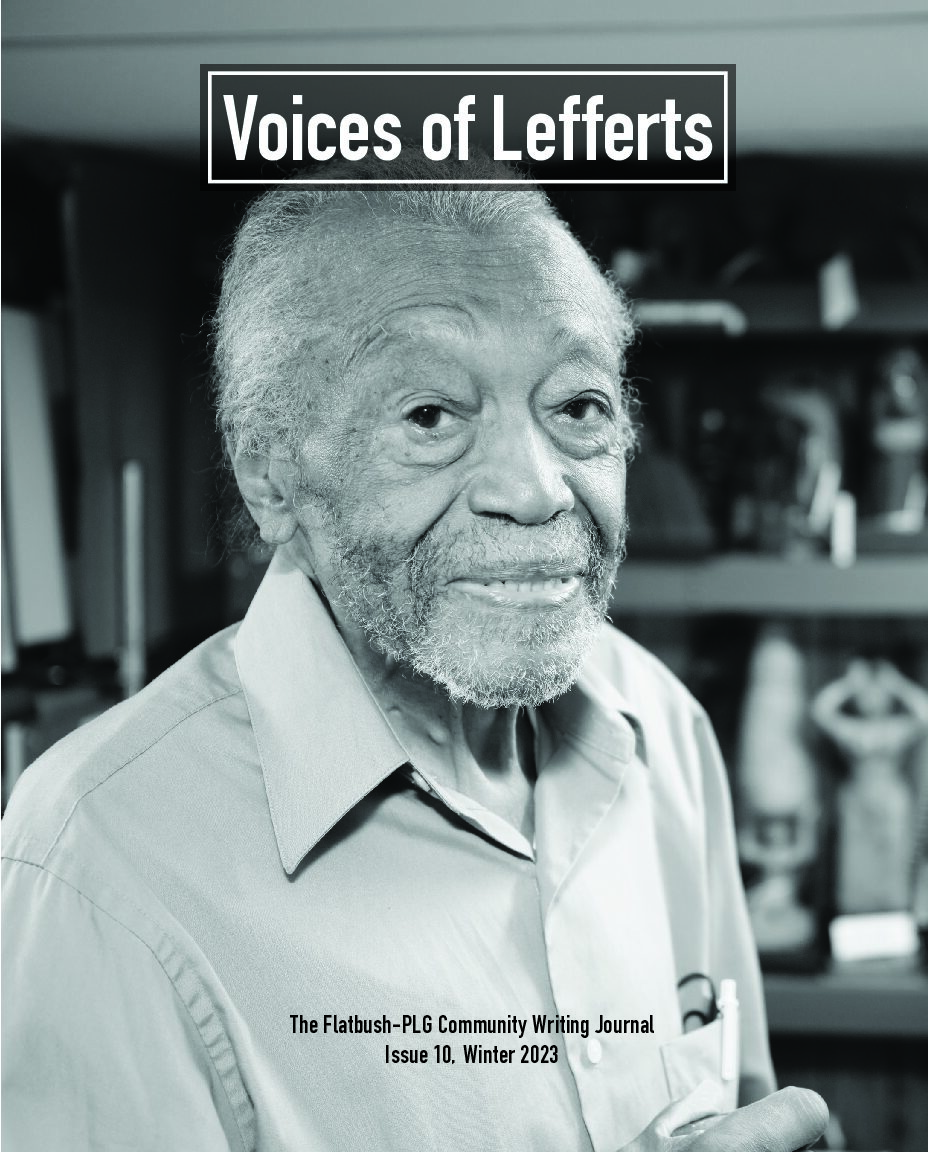
Issue 10, Winter 2023
Alex Richards
From Permits to Pony Rides: The Parkside Block Party
Timothy Hunter
New York City’s Underground Transportation System
Naomy Williams
Remembering Crown Heights
Otto Neals (featured artist)
Beauty, Power, and Love: The Life and Art of Otto Neals
Robert Gibbons
In Search of Collard Greens
Julia Keplinger
What We Need
Nancy Hoch
Plants and Their People
Oral History Excerpts
– Nancy Hoch interviews Irma Watkins-Owens
– Jon Earle interviews Natalie Sucre (Flatbush Eats collection)
– Ana Malagon interviews Luis Meza (Covid-19 collection)
Editorial Perspectives: Whose Streets? Our Street
THIS ISSUE OF Voices of Lefferts: The Flatbush-PLG Community Writing Journal marks our tenth since 2018. If we stopped publishing with a full set of ten issues, we would have succeeded in realizing our mission of contributing to neighborhood history through a collection of writing—essays, poems, excerpted oral history interviews—and images by and of the people who live here. Felicitously, thanks to the generosity of our readers and grantors, we are sailing full speed ahead into 2023 with a new initiative asking whose streets are these that crisscross Central Brooklyn.
Who decides that a high-rise building can be constructed? Who determines how our streets are policed, how much landlords can raise rents, and under what conditions? Who or what accounts for unequal education opportunities for our children? Or makes some of us frontline workers in the age of pandemics and allows others to work by Zoom from home? By the same token, who enriches our cultural life and how? What nurtures and delights us? Whose music? Whose art? Whose delicious roti and pizza and burgers and sashimi?
“Whose Streets? Our Streets!: Reclaim, Remain, and Rebuild” invites stories of struggle and joy that speak to the theme of “the right to the city,” a slogan and concept proposed in 1968 by French philosopher Henri Lefebvre. The initiative will invite participants to share stories about the rights to the city: affordable housing, economic justice, environmental justice, freedom from police and state harassment, safe neighborhoods, immigrant justice, and community control.
We aim to foster robust dialogue about these themes among youth, adults, and elders, homeowners and apartment dwellers, business owners and residents, school staff and students, children and families, immigrants and refugees, and police and community members. We are especially eager to hear from the youth. We take our subtitle from the Right to the City Alliance, which describes itself as “…a national alliance of more than 90 community-based racial, economic, gender [and] environmental justice organizations…[that aims] to defend our neighborhoods and build a robust and unstoppable movement to reclaim, remain in, and rebuild our communities” (righttothecity.org).
Throughout the year, we hope to encourage participants to consider the “right to the neighborhoods of Flatbush” through a wide-angle lens and multiple perspectives. Among the sub-themes we think may emerge are: violence and peace in local and global contexts, including how to change the narrative from one of policing, crime, and punishment to one of neighborhood safety and community control; and how to overcome racial and class divides that are exacerbated by the gentrification that sweeps whole communities up into seemingly inexorable forces of development and displacement.
Then, too, how might we support reparations for groups that have been excluded, denied, and hurt by systemic racism and other forms of oppression? What will it take to achieve full racial, gender, and class equality in our society? Our neighborhoods?
Among other stories we envision telling are the Flatbush African Burial Ground Coalition’s struggle to gain community control over the African burial ground on Church Avenue; the efforts to develop and sustain community gardens and environmental projects like composting, often undermined by the loss of public—or potentially public—spaces to real estate deals; tenant organizing to fight against rising rents and evictions; the quality of local public schools and the impact of Covid-19 on teachers, children, and families.
For the first time, we’ve formed an illustrious advisory panel of elected officials, community leaders, and organizations to help us identify themes and bring together a diverse group of residents to participate in an eight-week free writing workshop in winter 2023.
As always, participants will write and publish essays, poems, and works in other genres in Voices of Lefferts: The Flatbush-PLG Community Writing Journal. We’ll also hold author readings for each issue we publish and invite residents to participate in oral history training workshops, volunteer to be interviewed, and/or attend story circles and public forums.
VoL’s publishing and oral history programs lay a foundation for a workshop or an interview, but we can never predict the response we get. How participants see the questions we raise and, most important, who shows up to write are never predetermined. And what the writers or the oral history narrators have to say emerges in ways we can never entirely anticipate. But if I begin to imagine the written, oral, and photographic narratives likely to unfold this coming year, here are a few that strike me as having significance not only locally but also in the borough, the city, the nation, and beyond.
What might we discover, for example, about the Yemeni children who live in apartment buildings on Parkside Avenue and asked Alex Richards to paint the Yemeni flag on their faces at the annual block party (see Richards’ essay, p.11)? What has become of tenants whose rents have skyrocketed? Who, if anyone, has been evicted, and where have they gone? What about local stores that went out of business during the pandemic? Flatbush residents who lost loved ones during the pandemic or who have long Covid? Victims and culprits of spiking street and subway violence? What stories of policing will we hear—appeals for more vigorous law enforcement or for abolishing and demilitarizing the police?
“Whose Streets? Our Streets!” will invite participants to share stories about the rights to the city: affordable housing, economic justice, environmental justice, freedom from police and state harassment, safe neighborhoods, immigrant justice, and community control.
And what is the impact on Flatbush-PLG of national and international issues? Inflation and threats of a global recession; immigration and immigrant rights; women’s reproductive rights; climate change and intensifying hurricanes, wildfires, and extreme heat; voter suppression and the fragility of democracies worldwide; the January 6, 2021 attack on the Capitol and civil war; book banning and censorship; racial injustice and efforts in 38 states to restrict education about racism; nuclear Armageddon.
In what ways will we see these issues play out in the pages of Voices of Lefferts, the stories told by oral history narrators, and the neighborhood dialogue we hope to foster? In a widely disseminated TED Talk, Nigerian author Chimamanda Ngozi Adichie explains the danger of the “single story,” a stereotype of an individual, group, or nation that becomes fixed in the public imagination. Adichie recalls her experience as a college student in the US whose roommate was shocked that she speaks English well (the official language of Nigeria) and asked to listen to her “tribal music.” One of the most incisive remarks in her talk is that the problem isn’t that a stereotype is untrue but that it is incomplete.
We want to publish and record the many stories about Flatbush-PLG that give us a more complete understanding of our collective history: who we are, where we come from, and where we’re going.
In This Issue
This issue of the journal continues our mission of documenting neighborhood history in the words and images of those who live here and offers a preview of what’s to come with stories about neighborhood block parties, dollar vans, growing up in Crown Heights, collard greens, Prospect Park, and the power of plants.
In From Permits to Pony Rides: The Parkside Block Party, Alex Richards captures the joyful spirit—not without tensions and conflicts—of the renowned annual block party on Parkside between Flatbush and Bedford Avenues. She describes the frenzied preparations of the adults and all but unbearable anticipation of the children as the day approaches. By the end of the day, she sums up: “Pony rides and screeching children, wild and unsupervised. The 40-proof basket of cheer. Too-many icies and never-enough jerk chicken.”
Timothy Hunter takes us on a virtual ride through the history of dollar vans in New York City’s Underground Transportation System. He recalls, “The dollar vans are a constant reminder of my Afro-Caribbean roots; the sound of reggae music blaring through the radio always takes me back to my first dollar-van rides with my mom when they actually cost a dollar.” Take a ride with him to find out more.
In Remembering Crown Heights, Naomy Williams tells the story of growing up in Crown Heights. She recalls the building her grandfather bought in 1980 and the everyday life of a child in 1980s Brooklyn, resonating with “old renditions of doo-wop songs,” the smells and sounds of “fish Friday” when Charlie, the tire shop owner, sold fresh-caught fish, and the beautiful sunflowers that grew in her grandfather’s garden outside the building.
Otto Neals is our featured artist for this issue, and we couldn’t be prouder to celebrate his storied life and work. As he puts it in his artist statement, “I try to paint and sculpt African people, always working to portray those characteristics that are true of their beauty, their power, and their love. We are but shadows of those that have gone before us, and before I enter the world of the spirits, I hope, by example, to touch a positive nerve in our youth.”
Robert Gibbons returns to the pages of Voices of Lefferts with In Search of Collard Greens, offering a poetic rendering of life as we know it in Brooklyn and beyond. Robert takes us on a tour of supermarkets and bodegas and back to childhood memories of his grandmother’s potlicker, summer visits to his aunt’s garden in southern Georgia, and back to Prospect Lefferts Gardens, where he watches the collard greens “metamorphose in the pot.”
In What We Need, Julia Keplinger explores Prospect Park, weaving her delight in the grand achievement of Frederick Law Olmsted and Calvert Vaux into memories of her home in North Carolina. There, she and her younger brother chased one another in the woods as young children, “running beneath bent and braided branches” beyond her mother’s garden where she grew camellias. In Prospect Park, she discovers a “small building tucked into the base of Lookout Hill” that conjures still more memories of her mother’s garden and gives her comfort as a college student far from home.
In Plants and Their People, Nancy Hoch explores how plants help us connect more deeply to ourselves and our communities and those who have come before and those who will come after. In this powerful essay, she moves from the story of her mother’s garden deep in the New Hampshire woods, destroyed by new owners of the land after her mother’s death, to the loss of her husband Gene during the pandemic, to the story of the fight to create and preserve the Maple Street Community Garden.
Finally, we are thrilled to feature three oral history excerpts, each one extraordinary in its own right. The first is an interview with Irma Watkins-Owens, conducted this year by Nancy Hoch: “In my heart, in my emotions, in some ways, I’ve never left.” Also featured is an interview from our Flatbush Eats collection with Natalie Sucre, “You have to make an effort as a garden to be open,” interviewed by Jon Earle in 2021, as well as one with Luis Meza, “Then I got really sick. I got the coronavirus,” interviewed in 2020 by Ana Malagon as part of our Covid-19 collection.
- * *
Many thanks as always to all who make this community history project possible: interim oral history director Liz Oliver and oral history assistant director Kimberly Denise Williams; coaches Jenn Chen, Brenda Edwards, Robert Gibbons, Rina Kleege, Andrea Phillips-Merriman, and Norma Williams; copyeditors Annabelle Allen, Gillian Arthur, Sanjay Surana, and Nancy Hoch; photographers Nancy Treuber and Neil Carpenter; and graphic designer Frank Marchese. Acknowledgments also go to Greenlight Bookstore for ongoing support for us and many other community groups and projects, and to Park Slope Copy Center for consistently expert printing services. We are grateful to Humanities New York, the Citizens Committee of New York City, the Brooklyn Arts Council, LIU Brooklyn, the Prospect-Lefferts Gardens Neighborhood Association, the Lefferts Manor Association, and all of you, dear readers, for your support and participation in Voices of Lefferts!
By Deborah Mutnick