
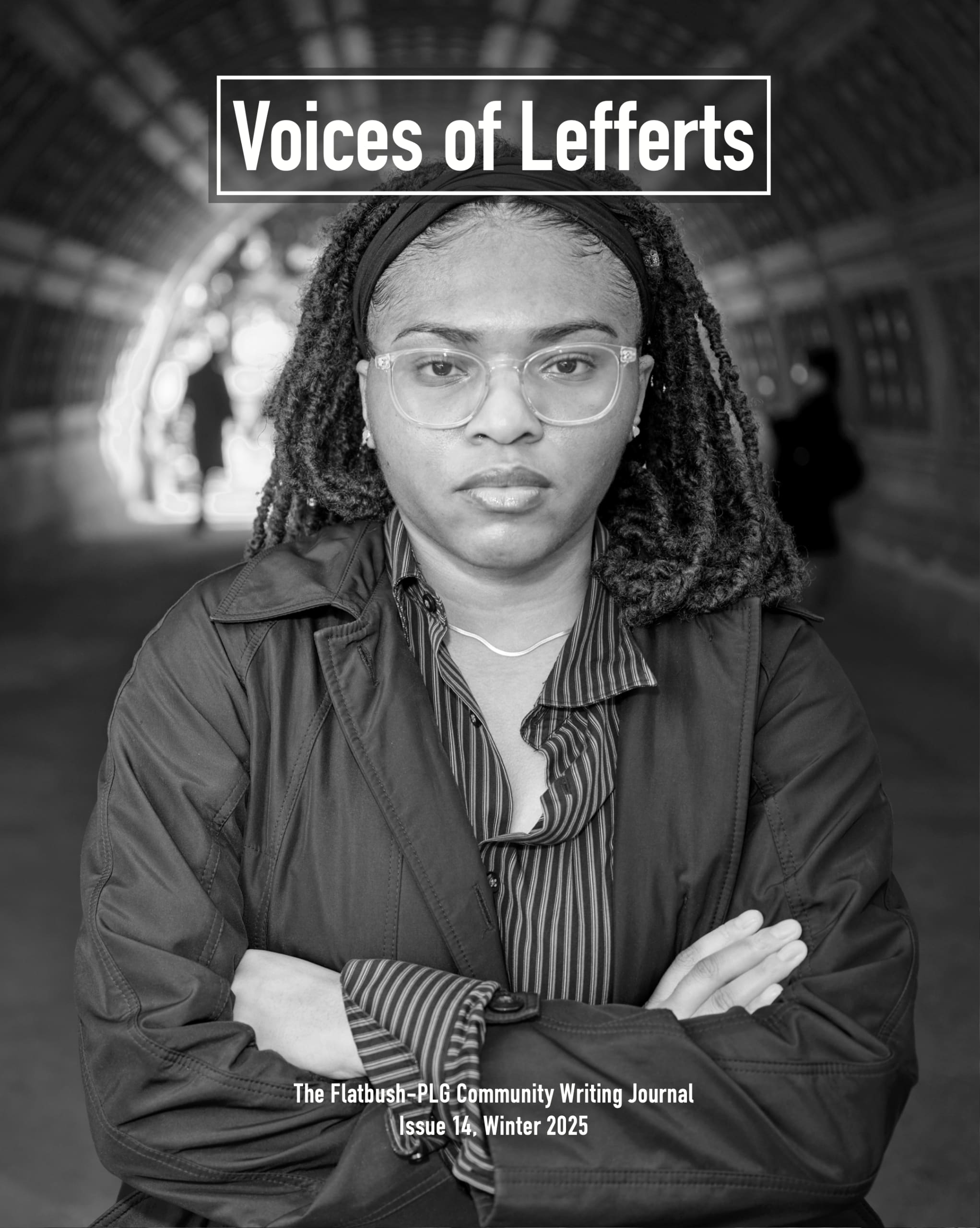
Issue 14, Winter 2025
Wini N. Murdaugh
A Garden to Admire
Jacob Kuhn
The Devil Is in the Details
Cindy Rene
Victor Honey
Carol Pittman
The Fight for Sunlight: How a Fight Against Gentrification Was Won
Neil Carpenter (featured artist)
Nadia Ketoure
Gratitude for the Practice of Qigong
From the Collections
— Jan Clausen interviewed by Hilary Seeley
— Jerrell Gray interviewed by Joshua Ocampo
— Richard Green interviewed by Hilary Seeley
Editorial Perspectives: Notes on the Course of History Mapping the Road Ahead
We recently held our first Voices of Lefferts oral history “listening party,” bringing together some 25 people to listen to excerpted interviews and reflect on what we heard, what we noticed, and what more we wanted to know. Interviewers, narrators, writers, project team members, and others who live in or near Flatbush-Prospect Lefferts Gardens (PLG) listened intently, charmed by audio clips that were introduced by interviewers and that featured narrators (interviewees), some of whom were present. Of all the themes that emerged in the recordings—immigration, COVID-19, gardening—the two that dominated the discussion that followed were gentrification and community. We were invited to jot down our reflections during the break. I didn’t have a chance to write that day, but here is what I’ve been thinking since then:
Gentrification is a topic that simultaneously unites and polarizes us across class and racial lines. We were all—in that room, anyway—opposed to Brooklyn’s seemingly unstoppable real estate development, foisted on us as “affordable housing,” belied by huge tax abatements for developers and 80 percent market-rate rents and prices for more affluent, whiter prospective renters and buyers that are moving into the neighborhood. But solidarity across those lines depends on where we come from and how that shapes us, even when we consciously betray our given class and racial status to be, as Noel Ignatiev put it, a race and/or class traitor. I can be a homeowner and identify with tenants’ struggles; I can be middle-class and white and identify with working-class and poor people of color. What I thought about at the listening party is that I am still a daughter of the middle class; I still embody whiteness—not “white fragility” or the belief that white people are unalterably racist, and no mea culpas, please—but in how I appear to the world and how I am treated.
People of color in the room that day spoke about encountering micro-aggressions in primarily white spaces and bonding with other students of color when they were in college in order to survive feelings of isolation, exclusion, and derision. This experience of being “othered” stood in opposition to the powerful sense of community they had felt growing up in Flatbush-PLG, then a predominantly African American and Afro-Caribbean neighborhood in which almost everyone said hello as they passed one another on the street. No matter how empathetic white people may be, that sense of double consciousness, about which W.E.B. Du Bois wrote so eloquently is neither their—our, my—burden to bear nor the gift of second sight.
Community is a topic that unites and polarizes us, too, across class, racial, and other lines of dif-ference. Flatbush-PLG has a history of forging solidarity across some of those lines, particularly in the formation of the Prospect Lefferts Gardens Neighborhood Association (PLGNA) in 1968. But it is also a fractured community with deepening tensions between affluent homeowners in Lefferts Manor-the twelve-square-block historic district created in 1893- and apartment dwellers, rich and poor, Black and white, newcomers and longtime residents, all haunted by the traces of those who have been driven out by rising rents and prices, a latter-day form of redlining, which also, shock-ingly, continues in subtle and not-so-subtle forms of racial discrimination in housing.
Gentrification, settling in, paying market rates, colonizing—regardless of skin color—what had become Black spaces by default is a cruel phenomenon, forcing out those who built equity into abandoned blocks in the late 20th century as white people fled to the suburbs. Dispossessed, dislocated, disenfranchised, symbolic racial codes carved into our bodies whether we like it or not, Black and white, the histories we carry with us alter the realities we experience, the worlds we see, feel, and hear, who we are and how we see one another, knowing that race and class are produced by history, but that no amount of knowledge or reason can expel the residue, the stink, of that history until we finally somehow permanently change its course. As wanderers in this century of dispossession and loss, we need signposts to mark the past and map the road ahead.
We—the collective mass of humanity—know how to change the course of history and have done so from our inception incrementally and, at times, suddenly, industriously and violently. But we haven’t exerted the full weight of our collective power to make the world habitable, safe, regenerative, equitable, and peaceful. If we knew how we’d stop everything and focus on what matters: children, the elderly, the frail, the sick, the poor, the outcasts, the homeless, the wounded; we would dissolve national borders, redistribute resources and wealth worldwide, and stop the climate crisis, genocidal wars, global dislocations, the evil of imperial might, and the expansion of markets from urban centers of wealth and culture to the farthest reaches of empire.
All of this is to say, we do what we can to change the stubborn, obdurate course of history, and we hope the sparks from our efforts light the way for those who stand with us today, shoulder to shoulder, and for those who follow. And it’s in that spirit that I am excited to let our readers know that we’ve been awarded a Humanities New York Action Grant to work with several local history and culture organizations to map Black history in Brooklyn. We will not start the revolution, but we hope to help clear a path forward.
Mapping Black History in Brooklyn Voices of Lefferts (VoL) is teaming up with Shanna Sabio and GrowHouse, the community design and development cooperative she founded, to expand the reach of the Black History + Heritage Corridor project she spearheaded. GrowHouse describes the Corridor as an initiative that “transcends mere preservation—the goal is to actively weave a cultural, ecological, and economic ecosystem that will connect Black historic sites like the Flatbush African Burial Ground, Lefferts Historic House, and Weeksville to each other and to contemporary Black-owned businesses using signs, heritage plantings, collaboration, and storytelling.” Each of these ecosystems—cultural, ecological, and economic—provides thematic strands for VoL writers and oral history interviewers to pursue.
For those just learning about Voices of Lefferts, the project was established in 2017 as a community writing journal and added an oral history component and art feature in 2019. Since then, we have published 13 issues of our biannual journal—this one is the fourteenth—and collected more than 60 oral history interviews, including themed collections on COVID-19, food, and “the right to the city.” Both the journal and our oral history collections are archived at the Center for Brooklyn History. Our mission is to document local history and culture in the words, voices, and images of the people who live and work in the Flatbush-Prospect Lefferts Gardens area.
As we embark on mapping Black history and culture in Brooklyn together with GrowHouse, we will be working with our partners to plan visits for writing workshop participants to Lefferts Historic House, Weeksville Heritage Center, the Center for Brooklyn History (CBH), and the Flatbush African Burial Ground. Our usual free writing workshop will focus on local Black history, scouring archives, touring historic sites, and working with historians, librarians, and archivists to develop content for the journal. The same historical and cultural content will infuse at least 15 oral history interviews and a podcast to be produced in conjunction with Grow-House. We will also support artists’ work to extend the signage to more Black history and culture sites along the Corridor, including QR codes that viewers can click on to access recorded walking tours, oral history excerpts, published essays, and podcast episodes.
A focal point of the yearlong project will be to work together with GrowHouse and other partners to mark the 400th anniversary of New Amsterdam’s founding and the occupation of Lenapehoking in 1625 and the ensuing local and national history of conquest, enslavement, and dispossession that we must reckon with today. The Black History + Heritage Corridor initiated by GrowHouse counters dominant narratives that Europeans who settled in New Amsterdam brought civilization to the wilderness of the new world, that slavery in Brooklyn was kinder and gentler than that in the South, and that the city’s ascent as a pluralistic, multiethnic, tolerant democracy foretold the country’s future. We aim to counter these narratives by demystifying long-lasting founding myths about our city and our nation.
To echo Chimamanda Adiche Ngozi’s remark that stereotypes are typically incomplete rather than untrue, dominant narratives reflect the partial, biased “truths” of the nation’s ruling classes. Writing in the New York Times about the New York Historical Society’s exhibit on the founding, which he curated, historian Russell Shorto quotes an unnamed Lenape chief addressing an ancestor: “Who could have known that a Dutch colonizer’s written words and 60 guilders would bring 400 years of devastation, disease, war, forced removal, oppression, murder, division, suicide and generational trauma for your Lenape people?” The chief goes on to say that this history also demonstrates their people’s resilience and that their stories must not be erased or forgotten.
Together with our partners, we are planning an explicit educational component for oral history interviewers and writing workshop participants. Without turning the workshop into an academic class or the writing into scholarly articles, we think the addition of readings and visits to local history sites and archives will inform and deepen workshop discussions and the essays, poems, and stories that emerge from them, all of which will contribute to disseminating this critical knowledge to new audiences. At CBH, librarians will introduce us to archival documents, deepening our knowledge of our collective past, present, and future. At Lefferts House and Weeksville, we look forward to tours and talks on Lenape and African descendant communities and Brooklyn’s first free Black community. In the fall of 2025, we hope to collaborate with our partners to plan a forum on the Black History + Heritage Corridor to share what we learn and build an audience for the project.
As we correct a historical narrative distorted by erasures, dehumanizing ideologies, and systemic exploitation—one that continues to unfold everywhere and is reasserting its worst aspects in many pockets of the US today, aiming to turn back the clock on civil rights, voting rights, reproductive rights, and more—pressing questions include: Who gets to tell the story? Whose voices get heard? And how best can they be broadcast, empowered, and preserved? What tools can unlock a deeper understanding in our multiethnic, multiracial city that no one is free until everyone is free, as Fannie Lou Hamer famously declared, and that our mutual collective interest is to create a society based on social and economic equality, ecological balance, cultural diversity, and freedom for all?
IN THIS ISSUE, we are pleased to present a variety of genres—essays, a poem, and excerpts not only from oral history interviews but also from our story circle, Flatbush 2050, which invited stories from the future of Brooklyn.
In A Garden to Admire, Wini N. Murdaugh imagines what the neighborhood will look like in 2030 or 2035 if the massive construction of buildings—small, mid-size, and large dwellings—continues and the apartments are sold or rented. “The neighborhood,” she laments, “will lose its charm and become another bustling urban area.”
Jacob Kuhn takes us on a journey through time in The Devil Is in the Details, describing Art Deco, Tudor Revival, and Neo-Federalist houses in Prospect Lefferts Gardens with the eye of a young landscape architect and a personal story. Along the way, he comments on change and continuity, both in profit-driven development across eras and the knowledge that “these buildings will watch over these streets long after we’ve left them, catching the afternoon sun…”
In her deeply felt poem Victor Honey, Cindy Rene pays tribute to a homeless Black man whose fate comes to symbolize his personal and social erasure, the burdens of blackness, and decomposition. “Debt,” she writes: “A covenant in color. blackness incurs debt at birth. debt is weight; what is, can, and will be held against you during your living. to whom does (y)our body belong?”
The struggle to protect the sunlight needed by the Brooklyn Botanic Garden (BBG) is the chief subject of Carol Pittman’s essay on gentrification in Flatbush neighborhoods, including Prospect Lefferts Gardens. In The Fight for Sunlight: How a Fight Against Gentrification Was Won, she reflects on her experience moving from the Bronx to Brooklyn decades ago and gives a short history of local anti-gentrification efforts, focusing on the BBG’s community-supported battle.
Our featured artist for this issue is VoL photographer Neil Carpenter, whose black-and-white photos of 2024 J’ouvert revelers and the West Indian Day beautifully document one of the most beloved, extraordinary celebrations of freedom in the world, ushering in a day of carnival music, dance, singing, and eye-popping costumes.
In Gratitude for the Practice of Qigong, Nadia Ketoure finds some answers to her lifelong questions about the existence of God and the purpose of life in the practice of qigong, a physical, emotional, and spiritual tradition rooted in Chinese wisdom. After discovering Qigong under a baobab tree in the US Virgin Islands, Nadia has been practicing ever since. She can be found with some of her followers every Friday at 9:30 am in Prospect Park.
Finally, in From the Collections, we present excerpts from three oral history interviews and a story circle held in late May on a perfect late afternoon at the Maple Street Community Garden. As the sun streamed through weeping willow vines, a group of local storytellers convened to imagine Flatbush 2050. Our three oral history excerpts feature Jan Clausen (interviewed by Hilary Seeley), Jerrell Gray (interviewed by Joshua Ocampo), and Richard Green (interviewed by Hilary Seeley).
* * *
As always, many thanks to all those who made this issue of the journal possible: oral history director Jon Earle; oral history assistant directors Kimberly Denise Williams and Isoke Senghor (farewell and good luck to Isoke, who is now a fully-funded History Fellow in the History master’s degree program at Rutgers University-Camden); coaches Brenda Edwards, Rina Kleege, Andrea Phillips-Merriman, and Norma Williams; copyeditors Sanjay Surana and Kris Walkes; photographers Nancy Treuber and Neil Carpenter; and graphic designer Frank Marchese. Thanks also go to Humanities New York, Park Slope Copy Center, LIU Brooklyn, the Prospect Lefferts Gardens Neighborhood Association, PLG Arts, Loud Baby, and CaribBeing. And thanks, once again, to all of you, dear readers, for your continued support of Voices of Lefferts!
By Deborah Mutnick