
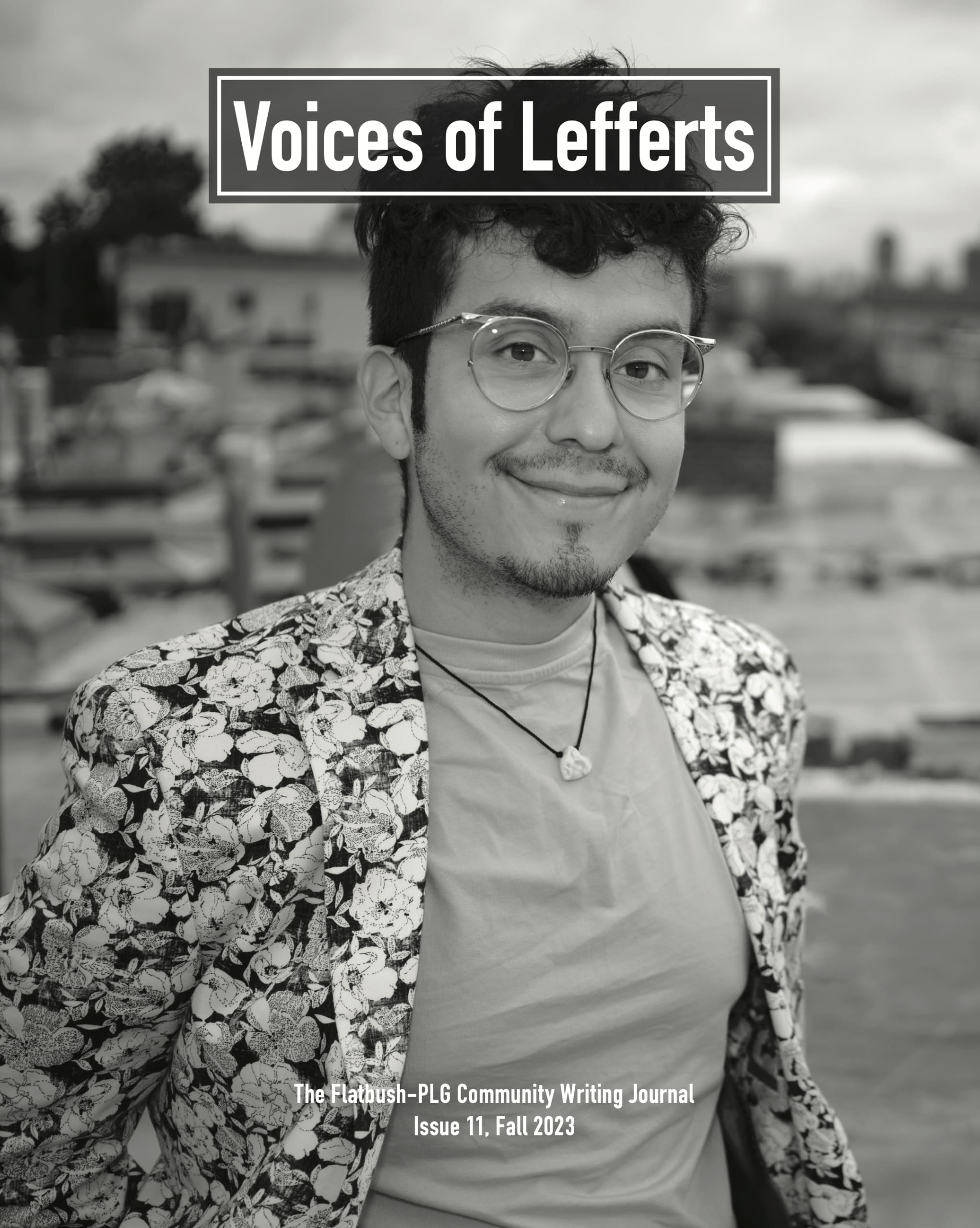
Issue 11, Fall 2023
Hannah Roth
Whose Names? Our Names.
Wini N. Murdaugh
Walking
Salma Salah
Saturdays in Prospect Park
Jean Dominique Volcy (featured artist)
Ricky Diaz
Front Door Ghost Goes to Vermont
Laquane Suarez
My Trip to the United Nations for Down Syndrome Day
Naeemah Senghor
Wanting to Please
From the Collections
– Halimeda Glickman-Hoch interviewed by Nancy Hoch
– Hogarth Hippolyte interviewed by Jon Earle
– Andrew Drury, an oral history conducted by Ron Drenger
Editorial Perspectives: Whose Streets? We’re Here and We’re Not Leaving—or Are We? And Who Is “We”?
As regular readers of the journal know, Voices of Lefferts was inspired by the Federal Writers’ Project (FWP), a 1930s New Deal program that put unemployed writers, teachers, secretaries, librarians, and other white-collar workers back to work writing state guides, collecting folklore, and interviewing diverse Americans, including more than 2,300 formerly enslaved people. The story of the FWP resurfaces whenever there’s a financial crisis—1973, 2008, 2020—as a way to support journalists, writers, and artists whose livelihoods, rarely secure to begin with, suddenly are at even greater risk. Perhaps it was the resurgence of interest in the FWP in 2020, during the first year of the pandemic when it looked like we might, indeed, be headed for another Great Depression, combined with increased scholarship on the project since 2008 that occasioned a one-day symposium eighty years later reconsidering its achievements.
The symposium was held at the Library of Congress—the largest repository of FWP archives—on June 16, 2023, and centered on the publication of the first book of collected essays on the project, Rewriting America: New Essays on the Federal Writers’ Project, edited by Sara Rutkowski. I had the good fortune to be part of this reassessment of the FWP’s short-lived existence from 1935 to 1939, which featured scholars and practitioners engaged in foundational and new research recovering the history, administration, complexities, and lost voices of the project, along with contemporary educational and public humanities programs involving new audiences in its work, methods, and democratic ethos.
The keynote speaker was Alessandro Portelli, an Italian professor of Anglo-American literature at the University of Rome La Sapienza and world-renowned oral and public historian. As a young man studying American literature in the 1960s, Portelli traveled to the U.S. to learn more about the songs of Woody Guthrie. Much of his work as an oral historian since then has been in Harlan County, Kentucky, where he collected interviews that explored the memories and culture of coalminers and other residents of this isolated part of Appalachia. More recently, he has been collecting migrant songs and stories in the streets of Rome.
FWP administrators Ben Botkin and Sterling Brown, both of whom influenced the project’s approach to life histories, insisted that folklore is living, culture is dynamic, and new traditions are continually made and remade. Like them, Portelli understood culture as a living, ever-unfolding process, not a relic of the past. He often heard Italians wax nostalgic for the past as expressed in a 1940s song “Roma Forestiera”—Rome the Stranger—that laments the disappearance of music from public spaces. But the streets, Portelli discovered, were full of music by migrants from Latin America, Africa, the Middle East, and Asia. Thus, the idea of “contamination” of traditional folklore has given way to an understanding of its fluidity, everyday resonance, and constant reinvention, particularly in urban spaces, worldwide.
If we look at cultural life in cities today, including Flatbush, Brooklyn, we see the comings and goings of priced-out Manhattanites from across the river, aspiring artists and students drawn to New York City, and migrants from across borders and seas, all of whom produce a rich, “cultural bouillabaisse,” as Yale Professor Robert Thompson called it, of stories, songs, poetry, practices, likes, dislikes, and beliefs. But we also see another trend that counteracts this pluralistic mix of who we are always in the process of collectively becoming. This trend of higher and higher prices and rents, demolition of historic houses, construction of new, high-rise buildings, and arrival of more affluent and whiter populations works to displace longtime residents, especially those who built the neighborhood during decades of disinvestment and white flight. And with these pressures on racially and ethnically diverse working-class people, migrants, and young artists and activists, rather than a plethora of songs, stories, and histories, we see a homogenization of culture, a flatter, narrower, more static, conventional way of being, talking, acting, dressing, and thinking. We risk losing the very dynamism that draws people here and energizes the neighborhood.
Such tensions between culture and economy, multiculturalism and monoculturalism, enforced by the laws of the free market, complicate the question Voices of Lefferts is asking in our current initiative: “Whose streets?” For these are not linear, clearcut, straightforward historical transformations; rather, they overlap and intertwine, with both realities—the continual making and remaking of culture and the threat of homogenization to its vibrancy—coexisting and competing with one another. And so again, we ask: Whose streets? Are these our streets? Yes? No? Sometimes? To an extent? What does that mean? What stories can we uncover by asking the question? Portelli writes that the migrants in Italy, for whom Rome had become home, would sing, “We’re Here and We’re Not Going Back.” The refrain of a song of resistance in Flatbush might go, “We’re here and we’re not leaving.”
* * *
AS IS TRUE WITH EVERY NEW GROUP of writers who attend our free community writing workshops, we have no idea what stories will be told or what points of view they will reflect. We invite a theme—in this case, whose streets, or who has the right to the city, and what does that mean—and frame a conversation. The rest is like throwing coins for the I Ching. Fortuitously, in this first of two issues of the journal on this theme, Hannah Roth starts us off with her essay on renaming streets, rethinking public monuments, and reclaiming public spaces.
The remapping of place in accordance with new understandings of history accelerated after the murder of George Floyd in 2020 and the massive global Black Lives Matter protests that filled the streets of cities worldwide. Monuments to slavery were torn down in the U.S. and abroad, literally tossed into the sea, as efforts redoubled to pay tribute to those whose contributions to local history have not been recognized and to reimagine historic sites to retell the past through the eyes of those whose labor, voices, suffering, and joys have been silenced, rendered invisible, and misrepresented—stories of migrants, Black and Indigenous people, women, children, workers.
Two major efforts to retell local history more accurately are happening in Flatbush, Brooklyn: Reimagine Lefferts, which seeks to “re-envision the mission and programming of the Lefferts Historic House museum to focus its interpretation and programming on exploring the lives, resistance, and resilience of the Indigenous people of Lenapehoking, whose unceded ancestral lands the park and house rests upon, and the Africans enslaved by the Lefferts family”; and the Flatbush African Burial Ground at 2286 Church Avenue, preserved for posterity by a coalition of forces that fought against the city’s plan to develop the lot on which it exists. The New York City Parks Department is now inviting the community to engage in conversations about how best to honor and memorialize the burial ground.
Just as the FWP sought to record a “people’s history” of the Depression era, we aim with “Whose Streets? Our Streets!” to document the past and present streets of Flatbush as together we imagine the future we want. What does that look like? Whose streets are these? Whose voices rise above the cacophony of honking horns and racing motors? Whose are muffled? Absent? Whose faces do we/will we see as we walk down Flatbush Avenue? Picnic, run, bicycle, and play in the park? What stores do we pass as we walk through the neighborhood? Which ones do we enter? Where do we shop? Dine? Grab a coffee or a tea? Some roti? Jerk chicken? Hummus and falafel? A bowl of wonton soup? A tamale? What songs do we sing? What books do we read? Who works here? Tends the grills? Rings up merchandise? Gives pedicures and cuts, curls, dyes, and shampoos hair? What carpenters, contractors, roofers, plumbers, electricians, gardeners, homemakers, and caregivers traverse these streets? Which small business owners and tech industry workers? Which doctors, nurses, lawyers, teachers, writers, artists, filmmakers, musicians, and dancers?
These are the everyday stories—the life stories—we hope to collect. Fittingly, my presentation at the Library of Congress symposium on the FWP on June 16 was about Voices of Lefferts: we are now part of a longer, wider effort that stretches before and after the federal writers went on the payroll of the New Deal to rediscover America, then as now a multicultural nation often portrayed through a single, dominant, monocultural lens yet promising freedom, equality, and democracy for all.
* * *
IN THIS ISSUE, we begin with the essay, Whose Names? Our Names.F, in which Hannah Roth contemplates what it means to name and rename local streets and sites. Parkside Playground becomes Winthrop Playground, renamed mysteriously after the first governor of Massachusetts. Why not honor someone in Flatbush? When her son came home and asked if she knew about Jean-Jacques Dessalines and the Haitian Revolution, she was able to tell him, yes, she looked up Dessalines when she noticed a street co-named for him on Rogers Avenue between Farragut Road and Empire Boulevard. She reflects: “And that is one of the many beautiful things about a name. It helps us mark and it helps us remember, but it also inspires newcomers to ask ‘Who is that?’ or ‘Why this block?’”
In Walking, Wini N. Murdaugh recalls her father’s love of that activity. Raised in Panama, he followed in the tradition of his mother, who walked all around Colon “picking various plants, flowers, fruits, herbs for her homemade teas, soups, seasonings, holistic medicines.” Wini’s mother’s family had also migrated from the Caribbean—Trinidad and Tobago—to Harlem, where her grandmother made “weekly walking excursions to the markets on Park Avenue…to purchase fresh fruits, vegetables, meats, fish, and ingredients for baking traditional Caribbean cakes and breads.” Walking as a child with her mother and father led her to Prospect Park after suffering deep personal losses. Now, as she walks along the East Drive, silently praying, she “feel[s] invisible weights of grief and sadness lifting from my shoulders.”
We take a turn to the gothic in Salma Salah’s Saturdays in Prospect Park. From when she first steps into the park one Saturday morning to the last shocking scene to which she bears witness a few weeks later, she shows the dark side of our green oasis from the city’s noisy, crowded streets. In an ironic commentary on what counts as local and national news, she disrupts our view of the park as idyllic. Finally, “It was the same drill again, much crazier this time. More vehicles. More cameras.” She thus leaves us to wonder whether the scenes she observes are part of nature, accidents, or signs of a society endlessly repeating the same story that sometimes makes the national news but just as often does not.
We are delighted to feature paintings by Jean Dominique Volcy in this issue of the journal. Volcy has exhibited his work in many venues, including the Restoration Center for Art and Culture, the Brooklyn Museum, the Bronx Museum, Dorsey’s Fine Art Gallery, La Maison des Arts in Montreal, Canada, the Museum of Natural History, and the Kenkeleba Gallery in Lower Manhattan. His works have also been depicted in many books, catalogs and newspapers, including Beyond the Borders, Art by Recent Immigrants (Bronx Museum), Masterpieces of Haitian Art, by Candice Russell and Brooklyn on My Mind: Black Visual Artists from the WPA to the Present, by Myrah Brown Green and Chirlane McCray.
Prospect Park also appears in Ricky Diaz’s essay, Front Door Ghost Goes to Vermont, which starts off with a description of “life-changing trips” to the park where he and his “queer, trans, first-gen, immigrant, and artist” friends sledded, meditated on trees, and gathered for picnics in the fall. Dedicating the essay to his grandparents, Eugenia Anderson and Julio Cesar “El Morocho” Anderson, and everyone who helped him feel like he belongs in Flatbush, Ricky takes us on a wild trip one snowy night out of the city to a house in Vermont. Together with his “pod,” one of many small groups that formed during the pandemic to weather storms of all kinds, he offers a tale of youthful joy and a bit of recklessness that reminded this reader of Ken Kesey’s Merry Pranksters and other bands of spirited young rebels.
Extending the question “whose streets” to “whose world,” Laquane Suarez recalls an eventful day in which he traveled from Flatbush to midtown Manhattan to visit the United Nations. In My Trip to the United Nations for Down Syndrome Day, he describes his excitement as he leaves home in the Young Adult Institute (YAI) van to meet Ms. Leanne at the subway station and take the 2 and the 5 trains to midtown. Impressed by the array of world flags—and not so much by the peas served in the cafeteria—Laquane attended the meeting, listening through an earpiece to speeches in honor of the day and concluding that the UN celebration of people with Down syndrome sends a great message to us all.
In Wanting to Please, Naeemah Senghor writes about her experience of helping people—patients at Downstate Medical Center, children, friends, the hungry, and the poor. Even as a young child, she recalls, she was known for her sympathy with others. At age nineteen, she changed her name to Naeemah, which means “benevolent.” Faced with her own challenges of agoraphobia, losing her home, and struggling to get by financially, she redoubled her efforts to help others, working in soup kitchens, making and distributing food, packing bags for those with dietary restrictions, and refilling community fridges. As many Flatbush residents know, she carried on this mutual aid work before, during, and after the pandemic, commenting, “While the pandemic is over, people’s struggles to have their basic necessities met persist.”
Finally, we are proud to include three oral history excerpts in this issue that speak to the theme of rights to the city, or “Whose Streets? Our Streets.” In interviews conducted respectively by Nancy Hoch, Jon Earle, and Ron Drenger, we feature Halimeda Glickman-Hoch’s “You Do the Thing to Demonstrate That You Care”; Hogarth Hippolyte’s “You Felt You Were Equal to Everybody Else”; and Andrew Drury’s “An Artist Residency Right Here in PLG.”
* * *
In acknowledging all those who make this community history project possible, I must begin by profusely thanking Jessica Stockton-Bagnulo and Rebecca Fitting, current and former owners of Greenlight Bookstore, and all the many staff members over the years who helped launch Voices of Lefferts into orbit. We are enormously grateful to them and very sad that the Flatbush store has closed. We wish them ongoing success in Fort Greene, the store’s original home at 686 Fulton Street, and promise to visit often. We are equally grateful to Vanessa Raptopoulos, owner of Awesome Home at 653 Flatbush, for so graciously agreeing to sell copies of the journal and host author readings. For the first time, we also have an advisory panel to thank: Richard Green, Cheikh Gueye, Timothy Hunter, Isis Sapp-Grant, Shanna Sabio, Steven Rice, Johari James, Shelley Worrell, State Senator Zellnor Myrie, State Assembly Member Brian Cunningham, and City Council Member Rita Joseph.
As usual, many thanks to the project team: our new oral history director Jon Earle; oral history assistant directors Kimberly Denise Williams and Isoke Senghor; website and project manager Liz Oliver; coaches Brenda Edwards, Robert Gibbons, Rina Kleege, Andrea Phillips-Merriman, and Norma Williams; copyeditors Sanjay Surana and Nancy Hoch; photographers Nancy Treuber and Neil Carpenter; and graphic designer Frank Marchese. Acknowledgments also go to Park Slope Copy Center, Humanities New York, Citizens Committee of New York City, LIU Brooklyn, the Prospect-Lefferts Gardens Neighborhood Association, PLG Arts, and Assembly Member Brian Cunningham, District 43, for a NY State Legislative Initiative grant. Thanks to all of our sponsors and to all of you, dear readers, for your support for Voices of Lefferts!
By Deborah Mutnick