
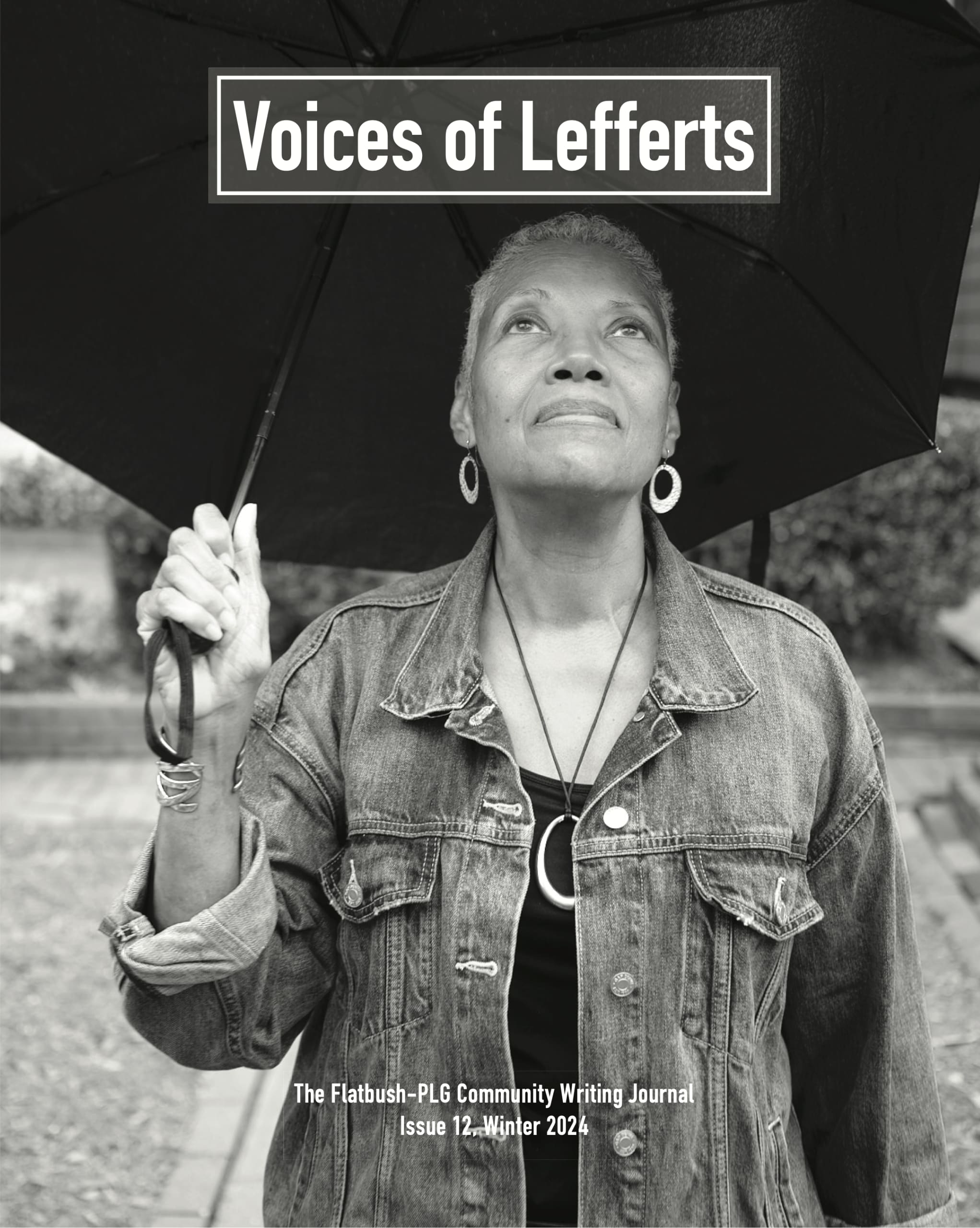
Issue 12, Winter 2024
Shanna Sabio
The Medicine of History
Naima Wood
Whose Street? Dorsey’s Street
Mari Rivera
It Was My Crown Heights, But Not My Parade
Omnia Khalil
Negating the DELI and the SELF
Marcia Lloyd (featured artist)
Jack Henry Robbins
I’m New Here / I’m Less New
Judy Spence
The Impact That As-of-Right Development Has Had on Our Community
Alison Novak
Taking Care
Oral History Excerpts
– Nikiesha Hamilton interviewed by Jon Earle
– Anna Allanbrook interviewed by Laura Zoe Dombrowski
– Tim Hunter interviewed by Michael Rance
Editorial Perspectives: Reclaim, Rebuild, Remain
On June 19, 1816, John Lefferts of the town of Flatbush sold a girl named Grace to Thomas Sands for 35 dollars. She had been born into slavery on the Lefferts’ plantation on August 11, 1802. She was to serve Sands until she reached the age of 25, a condition established by the New York State Act for the Gradual Abolition of Slavery in 1799 for all enslaved women born after July 4 of that year (men would remain enslaved until they turned 28). Slavery was abolished in New York State in 1827, so Grace would have been freed the same year her term of servitude would have ended.
The further terms of the slave bill of sale for Grace were that she would serve Thomas Sands “well and faithfully… orderly and obediently.” For his part and his heirs, executors, and administrators, Sands was to teach Grace “the duties of a servant girl” and give her some schooling and be sure she had “sufficient meat and drink and all other necessaries fit and convenient for her.”
I first encountered Grace’s story in 2011 as a participant in a three-year Fund for the Improvement of Post-Secondary Education grant awarded to what was then the Brooklyn Historical Society (BHS)—now the Center for Brooklyn History—to bring faculty from three nearby colleges into the archives to develop curricula for underprepared college students. Long Island University, where I teach, was lucky enough to be among them.
Among the courses we developed was one called Pathways to Freedom, which linked history and composition in a learning community focused on slavery in Brooklyn in the first semester, and the twentieth-century civil rights movement in the
IN THIS ISSUE, we are proud to present FABGC trustee Shanna Sabio’s essay, The Medicine of History. From her childhood in a rapidly changing Bushwick in the 1970s, transfigured by the 1977 blackout into a post-apocalyptic nightmare, to her central role in preserving and commemorating the local history of the burial ground, she tells a personal story that explains how she came to “see history as a form of future visioning, preserving stories as a way to resist displacement and the erasure that accompanies it.”
Naima Wood’s essay, Whose Street? Dorsey’s Street, focuses on one of New York City’s oldest Black-owned art galleries, established in 1970 by her grandfather, Lawrence P. Dorsey. For more than fifty years, Dorsey’s Picture Frame and Art Gallery has been a beacon for artists in Flatbush and beyond, especially Black artists who struggled to show their work in museums and galleries. In what is now known as Dorsey’s Fine Art Gallery, Naima is carrying on her grandfather’s legacy and his mission “to make art accessible for all.”
In It Was My Crown Heights, But Not My Parade, Mari Rivera takes us to President Street and Franklin Avenue, where she moved when she was in fourth grade. She chronicles the changes she began to see as she was growing up and the social divide marked by Eastern Parkway. Past the parkway, starting on Lincoln Place, the demographics changed. “…the air was different. There was a Starbucks, two banks, an espresso bar…” The West Indian Parade, she writes, was “the one thing that the people on the other side of Eastern Parkway couldn’t touch.”
Omnia Khalil’s essay, Negating the DELI and the SELF, meditates on estrangement and identity from the perspective of a newcomer navigating the actual and virtual maps of Flatbush. In working through the complex meaning of her identity as an Arab woman who left Egypt after the Arab Spring and encounters gender conflicts here with fellow Arabs and Islamophobia from storeowners, she concludes: “Prospect Lefferts Gardens is a microcosm of the processes of conquest, colonization, dispossession, and displacement forged by time and place.”
Our featured artist for this issue is Marcia Lloyd. Longtime PLG resident and accomplished photographer and leather sculptor, she shares a series of photographs of people and nature that illustrate the spirit of her work. Responsive as a child to “the quality of light, priming me to eventually become a photographer,” she observes that “Photography, after all, literally means ‘writing with light.’ Light sets the mood of a photograph and contributes to its emotional impact.” The photographs here amply demonstrate that ethos.
Next, we hear from another newcomer, Jack Henry Robbins, whose poems evoke what it’s like to be “new” in the neighborhood. In I’m New Here and a follow-up poem, I’m Less New, he conveys a story of what it’s like to grow up in the city, move away, and return. He writes that he left for a place of dreams and good weather, but Flatbush, where he comes back to like a fresh piece of chopped wood, “…is built on steel / Has plants & swans in winter. / I’m here for it.”
Judy Spence, whose essay, “Save Lenox Road!” appeared in the journal in issue no. 6 in 2021, contributes an open letter to elected officials and community leaders of Brooklyn Community District 17 on The Impact That As-of-Right Development Has Had on Our Community. Her eloquent plea for action to be taken to halt the destruction of homes and buildings was written the day after Community Board 17’s community forum on as-of-right zoning on February 15, 2023, at which she did not get a chance to speak. We are proud to give her a platform here.
Alison Novak gives us Taking Care, a richly layered essay about her experience as a relative newcomer on Lefferts 2 who befriends the block’s old-timers and writes lovingly about Rena St. Lawrence and her younger brother David, in particular, whose story leads to a deep dive into neighborhood history. As she puts it, “We can’t stop the neighborhood from changing, but we can invest time, energy, and sometimes cash, in creating or reinforcing the infrastructure that enables us to have the shelter and the community that we all need.”
Finally, we are delighted to feature three oral history excerpts in this issue that speak to the theme of “Whose Streets? Our Streets!” In interviews conducted by Jon Earle, Laura Zoe Dombrowski, and Michael Rance, respectively, we hear from Nikiesha Hamilton, “I felt like I had to leave. I needed to know if there was something more out there”; Anna Allanbrook, “We used to call it the other side of the park,” and Tim Hunter, “This community owes me nothing else. I feel like I owe it everything.”
* * *
We dedicate this issue to the memory of Duane Joseph, whose unexpected death on August 7, 2023, sent shockwaves through the community. Beloved by family, friends, neighbors, and colleagues, Duane was a beacon of light and hope in Flatbush. His untiring generosity and service to the neighborhood will never be forgotten. As a dedicated member of Community Board 14, he was known for having been “simultaneously critical of local government and a great believer in it. His participation served to instill in others that same confidence or at least willingness to strive toward solutions.” Duane was also one of the original founders of Parkside Plaza, advocating and fundraising for the transformation of a barren space in front of the train station into a place by and for the community. He is deeply missed, but his memory will live on in the legacy of goodwill, kindheartedness, and community leadership he left to us all. No one better exemplifies the enactment of the slogan “the right to the city” and the determination to reclaim, rebuild, and remain.
* * *
As usual, many thanks to the project team: oral history director Jon Earle; oral history assistant directors Kimberly Denise Williams and Isoke Senghor; website and project manager Liz Oliver; coaches Brenda Edwards, Robert Gibbons, Rina Kleege, Andrea Phillips-Merriman, and Norma Williams; copyeditors Sanjay Surana and Nancy Hoch; photographers Nancy Treuber and Neil Carpenter; and graphic designer Frank Marchese. Acknowledgments also go to our “Whose Streets? Our Streets” advisory panel, Park Slope Copy Center, Humanities New York, Citizens Committee of New York City, LIU Brooklyn, the Prospect Lefferts Gardens Neighborhood Association, PLG Arts, and Assembly Member Brian Cunningham, District 43, for a NY State Legislative Initiative grant. And thanks, as always, to all of you, dear readers, for your support for Voices of Lefferts!
By Deborah Mutnick