
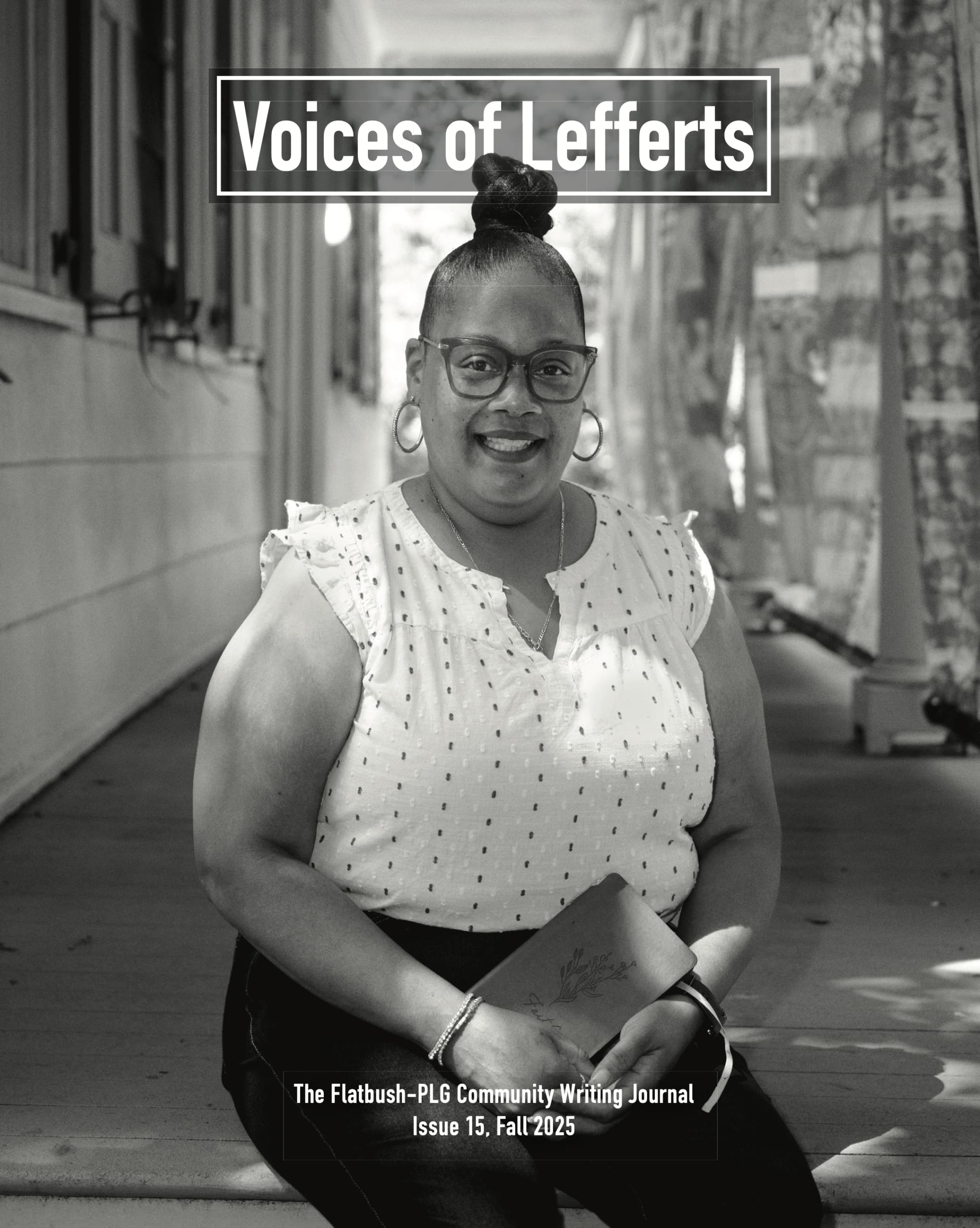
Issue 15, Fall 2025
Natasha Fearon
The Whispers of Brooklynites
Majella Mark
It Started with Eve
Robin Jackson
Handwriting Is Everything
Deborah George
An Intern’s Journey with Voices of Lefferts
Jennella Young (featured artist)
Raul Rothblatt
Georgina Putnam and the Fight to Integrate Brooklyn Schools
Priscilla Mensah
Reimagining ‘The Heights’: The Fascinating Story of the Free Black Croger and Gloucester Families of Brooklyn Heights
Alex Treuber
They Found Gold Under the Wendy’s on Flatbush Avenue
Brenda Edwards
Welcome
From the Collections
— Riah Kinsey, public program manager at Lefferts Historic House, interviewed by Sarah Schuster
— Rita Franklin, interviewed by Norma Williams
— Justin Moore, also interviewed by Sarah Schuster
Editorial Perspectives: Cartographies and Geographies Mapping Black History in Brooklyn
It is already July of 2025 as I write, and tonight is a respite from hotter-than-usual temperatures so far this summer. I can hear crickets outside, a woman’s laughter in the dark, traffic from Bedford Avenue a half-block away. I had thought to write about maps and acts of mapping, the cartographies and geographies of the neighborhood and metaphors of time and space, change and movement, history and place. Years ago, when I was first becoming interested in these ideas and thought I had discovered the secret to the universe in the chronotope, I recall a small group of young progressive architects by the name of Place in History, a nonprofit group founded in 1997 that “examines urban development, decay, and redevelopment through community-based public art and public history projects” in New York City neighborhoods.
I had begun to study theories of space and time, the Russian philosopher Mikhail Bakhtin’s theory of the chronotope (time/space) as fusing time and space in literature, a concept that translates to everyday life and the intersection of history, the arrow of time, and place, the horizontal plane that accretes layers and layers of memory in the sidewalks and streets we tread on every day. It fascinated me: the acceleration of time, the compression of space, clichés by now but such powerful evocations back then of the world I felt spinning around me, all the fashionable postmodern tropes of doctoral studies at the turn of the century, distances traversed in hours instead of weeks or months, time that went by faster than those calendar pages flipping through years in 1930s B movies.
I don’t mean to digress, to wax poetic; it must be the stillness of this early July night in Brooklyn at 11:34 pm. But history and place—and acts of placemaking—are at the heart of all communities, including ours. And my meditations on the meaning that these nodal points of everyday life have for all of us are inspired by the poets, writers, and artists included in this issue who are telling the story of Black history in Brooklyn, many of them tracing, retracing, citing, imagining, or reimagining alternative histories and speculative futures based on our visits to Lefferts Historic House, the exhibition “Trace/s: Family History Research and the Legacy of Slavery in Brooklyn” at the Center for Brooklyn History (CBH), the Weeksville Heritage Center, and the Flatbush African Burial Ground.
Last fall, Voices of Lefferts joined forces with a project begun by Shanna Sabio’s GrowHouse Design & Development Group. Also a co-trustee of the Flatbush African Burial Ground, Shanna describes the Black History + Heritage Corridor as a project that “transcends mere preservation,” explaining that “the goal is to actively weave a cultural, eco-logical, and economic ecosystem that will connect Black historic sites like the Flatbush African Burial Ground, Lefferts House, and Weeksville to each other and to contemporary Black-owned businesses using signs, heritage plantings, collaboration, and storytelling.”
We teamed up to apply for a Humanities New York grant, which we were thrilled to receive, only to learn a month or so later that the funding was rescinded by one of the Trump Administration’s 166+ executive orders this year that prohibited the National Endowment for the Humanities (NEH) from promoting “gender ideology,” “environmental justice initiatives and activities,” “discriminatory equity ideology,” and “DEI/DEIA” (the “A” stands for “accessibility”!). All state humanities councils, whose grantmaking depends on NEH support, were forced to cancel existing and new grants, including ours. If it weren’t so outrageous, the list of proscribed activities would be hilarious, fodder for a farce about some imaginary banana republic’s absurd worldview.
Meanwhile, we have continued to apply for funds, receiving one smaller grant from the Brooklyn Arts Council—thank you BAC!!!—and waiting to hear about others, but the consensus of the project team and the unusually large number of participants who signed up for our annual workshop this year has been unanimously and enthusiastically to continue the Mapping Black History in Brooklyn project with or without financial support, declaring as if with one voice that this work is more vitally important than ever.
More than 50 people have been involved in the project this year—so many that it was sometimes hard to keep track of who was who. We have artists, writers, historians, researchers, storytellers, and archivists working with us to map local history, learning together about our collective past and transforming this knowledge into expressions of what it means to us today; for example, to walk through Lefferts Historic House where Betty, Cato, Isaac, Mercy, and Yaft worked, or to behold at the exhibit “Trace/s” the very formal portrait of slaveholder John A. Lott (1806-1878) hanging beside Brooklyn artist Rusty Zimmerman’s portrait of Brooklynite Mildred Jones, the living great-great-granddaughter of Samuel Anderson, born enslaved to Lott’s uncle Jeremiah Lott. In the portrait, according to family lore, she is holding a cowbell that belonged to Samuel.
At Weeksville, we visited the three houses remaining from different time periods of the free Black community that started in 1838—a small one-story double house common in the 1800s; a second house dating from the mid- to late-1800s, with a bigger kitchen, an upstairs with fireplaces in each room and gas-powered lighting; and the third house, from the 1930s, with a patio, garage, appliances, piano, electricity, plumbing, and bathroom with bathtub. And our group went on Shanna’s walking tour of the Flatbush African Burial Ground at 2286 Church Avenue, where researchers have determined that Sarah Hicks, née Jacobs, born in 1785, and Eve were both buried. Eve, who died at 110 years of age in 1810, was described as “a woman of strong intellectual capacity” in an obituary in the Long Island Star.
Although the order of the site visits was pragmatic, we ended up rehearsing the project map in space and time as if we had planned the workshops to coincide with the geography and history we were tracing: Our map of Black history had begun to materialize. We started with the Lefferts family, the house they built around 1783, and the people enslaved there, and then proceeded to the exhibit at the CBH of John A. Lott, born in 1806; Samuel Anderson, his contemporary, born into slavery; and his great-great granddaughter Mildred Jones. Then to Weeksville, a free Black community that existed from 1838 to the 1930s; and finally, full circle, to the Flatbush African Burial Ground with its transhistorical presence stemming from the burials of all those laid to rest there from the 17th century through the early 1840s to the recovery of our memory of them and the community struggle to memorialize them over the past 10 years.
In that spirit, I share a poem inspired by our visit to Lefferts Historic House in March that I wrote as soon as I got home; it was still cold outside that day but redolent with the smell of spring.
In This Issue
We proudly present the first of several issues on Mapping Black History in Brooklyn, starting with Natasha Fearon’s wonderful series of poems and prose, The Whispers of Brooklynites, which brings to life the builders, planters, cooks, farmers, and gardeners of Lefferts Historic House even as the house itself gives voice to its yearning for those who passed through it and appreciation for those who started a few short years ago to reimagine its presence in Prospect Park.
Majella Mark continues to document Black life in Brooklyn in It Started with Eve, a series of letters paying tribute to women whose legacies shine light and love on the history of Flatbush. Interweaving the personal with the political, she includes family members like her grandmother Illis Lewis and historical figures like Eve, who lies buried in the Flatbush African Burial Ground, and political heroes like Shirley Chisholm, the first Black female candidate to run for president of the US.
Robin Jackson’s poem, Handwriting is Everything, celebrates literacy as an art that represents who we are and that was not taught to African Americans in Brooklyn for hundreds of years but was something they learned in secret, in the shadows, perhaps so they could forge freedom papers. With that knowledge, from “hieroglyphics in pyramids” to “documentation of science and mathematics,” Jackson declares, came the power of “telling our new stories” to write songs, music, books, and history.
An Intern’s Journey With Voices of Lefferts is Deborah George’s reflection on the project of mapping Black history in Brooklyn. A Bronxite attending college in downtown Brooklyn, she knew very little about this borough. But she learned a lot as a VoL intern, one of two spectacular notetakers whose meticulous reports on site visits record them for posterity, informing the story of her personal journey and the collective creation, as she put it, of “a self-portrait of Brooklyn.”
Our featured artist in this issue is Jennella Young, who has lived in Bed-Stuy and Flatbush for most of her life. Her remarkable collaged portraits document not only her own exploration of “Black memory, place, and survival” in these neighborhoods but also the project of mapping that journey, as she says, “Not just physically, but emotionally. Spiritually. Historically.” Mapping Black history to her means “marking the places that tried to forget us—and insisting we were always here.”
Raul Rothblatt’s Georgina Putnam and the Fight to Integrate Brooklyn Schools recovers to our collective memory the little-remembered name of a significant Black educator. In 1893, Putnam played a key role in integrating the first public school and teaching staff in Brooklyn. But that’s only part of the story Rothblatt tells, of a local drama between Putnam, white residents who had by then moved to Weeksville, and a fellow Black educator, T. MCants Stewart. Read Raul’s piece to find out what happened.
In an introductory poem, “I, Too, Sing Brooklyn Heights,” Priscilla Mensah asks if it was always the case that very few Black people like her lived in the very pricey neighborhood of Brooklyn Heights. She then goes on to answer that question in her accompanying essay, Reimagining ‘The Heights’: The Fascinating Story of the Free Black Croger and Gloucester Families of Brooklyn Heights, about two Black families who were among the neighborhood’s earliest settlers.
In his tour de force They Found Gold Under the Wendy’s on Flatbush Avenue, Alex Treuber tells the story of the discovery in 2028 under the Wendy’s at 469 Flatbush Avenue. Thought to be worth some $5,485,710, the contested windfall of pure gold coins eventually goes to the Supreme Court, which rules that the chest of gold belongs to its rightful owner according to “provable historical origins.” Theories abound. To find out which one prevails, turn to page 57.
Brenda Edwards, longtime VoL editor and frequent contributor to VoL, offers a spoken-word piece simply titled Welcome. Originally performed at *7 7*, a local event series, the prose poem welcomes us to the world of Black women who have long been feeling what has become more widely felt of late: “suppressed, saddened, terrorized, traumatized, victimized, criminalized…in the bowels of the capitalist class.” But all is not lost, she writes, paying tribute to a short list of the many diverse “African Queens,” from centuries ago and today, who guide us.
Finally, in this issue we are pleased to present excerpts of three oral history interviews From The Collections. Riah Kinsey, public program manager at Lefferts Historic House, interviewed by Sarah Schuster, remembers growing up in Brooklyn and Queens, doing “archeological excavations” in his backyard as a kid, and how he decided to become an archivist. Echoing Paule Marshall’s account in Brown Girl, Brownstones of 1930s Bajan migrants to Brooklyn whose mantra is “buy house,” Rita Franklin tells Norma Williams what the city was like when she moved from Virginia to Brooklyn as a child in 1963, how it has changed since then, and what advice she would give to young people today: “Have a piece of property. Leave your legacy with your children.” Last, polyglot Justin Moore, also interviewed by Sarah Schuster, narrates the story of his life from becoming fluent in Spanish because he was “a very nosy kid” and proficient enough in other languages to communicate in them, almost becoming a linguist, then going into graphic design and typography, and ultimately “just yapping… having fun, just gabbing away.”
The Project Team
As always, many thanks to the Project Team—editors Brenda Edwards, Norma Williams, Rina Kleege, Carol Pittman, Sarah Schuster, and Alexis Hutchinson; photographers Nancy Treuber and Neil Carpenter; copyeditors Sanjay Surana and Kris Walkes; and graphic designer Frank Marchese. Special thanks to Shanna Sabio for guiding our journey to map Black history in Flatbush, including her walking tour of the Flatbush African Burial Ground, and to Dylan Yeats and Riah Kinsey for hosting us at Lefferts Historic House, Dominique Jean-Louis for giving us the tour of “Trace/s” at the Center for Brooklyn History, and Erica Harper and the tour guides for hosting and leading us through the three historic houses at the Weeksville Heritage Center that were inhabited by members of this historic free Black community. Even though we didn’t get the grant from Humanities New York, we thank them for trying and look forward to finding new ways to work with the staff to create, disseminate, and preserve the important work of the humanities. We are also deeply grateful to the funding provided to us by the Brooklyn Arts Council. Finally, a shout-out to Compound Cowork, which has become our home for in-person workshops, author readings, and other events, and to Park Slope Copy Center for continuing to print the journal and help us bring each issue into the world. And thanks to you, dear reader, for supporting our work; it is for you that we exist.
By Deborah Mutnick